
Insights
Aug 16, 2026
Roofing lead generation: proven strategies for 2026
Roofing lead generation: proven strategies for 2026
Discover proven strategies for roofing lead generation in 2026. Optimize your search presence, enhance your website, and capture high-quality leads!
Discover proven strategies for roofing lead generation in 2026. Optimize your search presence, enhance your website, and capture high-quality leads!
Roofing lead generation: proven strategies for 2026
The fastest way to build consistent, high-quality roofing leads is a three-part system: a fully optimised local search presence, a website that captures leads with an instant estimator, and one paid channel running while you tighten your speed-to-lead process. This combination wins because it stacks high-intent traffic from your Google Business Profile and Local Services Ads with the conversion lift of instant quoting tools and fast follow-up, rather than relying on any single tactic.
Here’s what to do in week one:
Claim and fully verify your Google Business Profile with real job photos.
Add click-to-call and instant estimate widgets to every service page.
Set up automated SMS acknowledgement for every new enquiry.
Pick one paid channel (Local Services Ads or Google Ads) and commit a test budget.
Roofers who respond within five minutes of a lead landing convert at dramatically higher rates than those who wait even an hour, according to Roofr’s 2026 lead generation research. Speed is not a nice extra here. It is the difference between winning the job and funding a competitor’s marketing budget.
Pro Tip: Don’t launch five channels in week one. Get your Google Business Profile verified and your estimator widget live first. Everything else builds on that foundation.
Key Takeaways
Consistent, high-quality roofing leads come from stacking a fully optimised local search presence with an instant-estimator website and one well-managed paid channel, backed by a five-minute response workflow.
Point | Details |
|---|---|
Start with organic foundations | Claim and verify Google Business Profile before spending on paid channels. |
Add one paid channel at a time | Test Local Services Ads or Google Ads and measure cost per booked job. |
Build instant capture into your site | Install an estimator widget and capture data fields in the right order. |
Respond within five minutes | Automate SMS acknowledgement and quoting to win jobs before competitors call back. |
Vet partners on transparency | Choose a provider like Sun State Digital that reports clearly and guarantees territory exclusivity. |
Table of Contents
What channels actually generate roofing leads?
Which website features turn clicks into booked jobs?
How fast should you respond to a new roofing lead?
How do referrals and reviews lower your cost per lead?
What role does AI play in roofing lead generation?
How much should you budget for roofing leads?
How do you choose a roofing lead-generation partner?
What does a real roofing lead-generation result look like?
What should your first 90 days actually look like?
Ready to fix your roofing lead pipeline?
Frequently asked questions
Sources
What channels actually generate roofing leads?
Start with the channels that compound before you spend a dollar on ads. Your Google Business Profile, loaded with finished-job photos and a steady stream of reviews, drives the “roofer near me” searches that convert at the highest rate because the homeowner is already looking for exactly what you do. Local content, referrals, and a well-optimised website round out this free tier. None of it is instant, but all of it keeps paying you back long after you stop actively working on it.
Paid channels fill the gap while your organic presence builds. Local Services Ads (LSAs) put you in front of homeowners with a “Google Screened” badge and pay-per-lead pricing, which tends to suit smaller teams testing their first paid channel. Search ads through Google Ads give you more control over keywords and landing pages but require tighter management. Geo-targeted social ads work well for brand awareness and retargeting website visitors, though they rarely produce the same intent-to-call rate as search-based channels.
Then there’s the gap-fill tier: verified-call providers and lead marketplaces. Providers using OTP verification and bot detection can screen out junk leads before they ever hit your phone, according to Elevarus, which makes them useful when you need volume fast. Treat these as a stop-gap, not your foundation. They cost more per lead over time and don’t build any asset you own.
Judge every channel by cost per booked job, not cost per lead. Test one paid channel at a time so you actually know what’s working.
Pro Tip: Pick four channels for the season, one compounding (GBP or reviews), one capture (your website), one paid (LSAs or search ads), and one outreach (referrals or local partnerships), and run them consistently rather than chasing whatever’s trending this month. SimplyWise’s research backs this “pick four and commit” approach as the most reliable operational rule for roofing lead sources.
Which website features turn clicks into booked jobs?
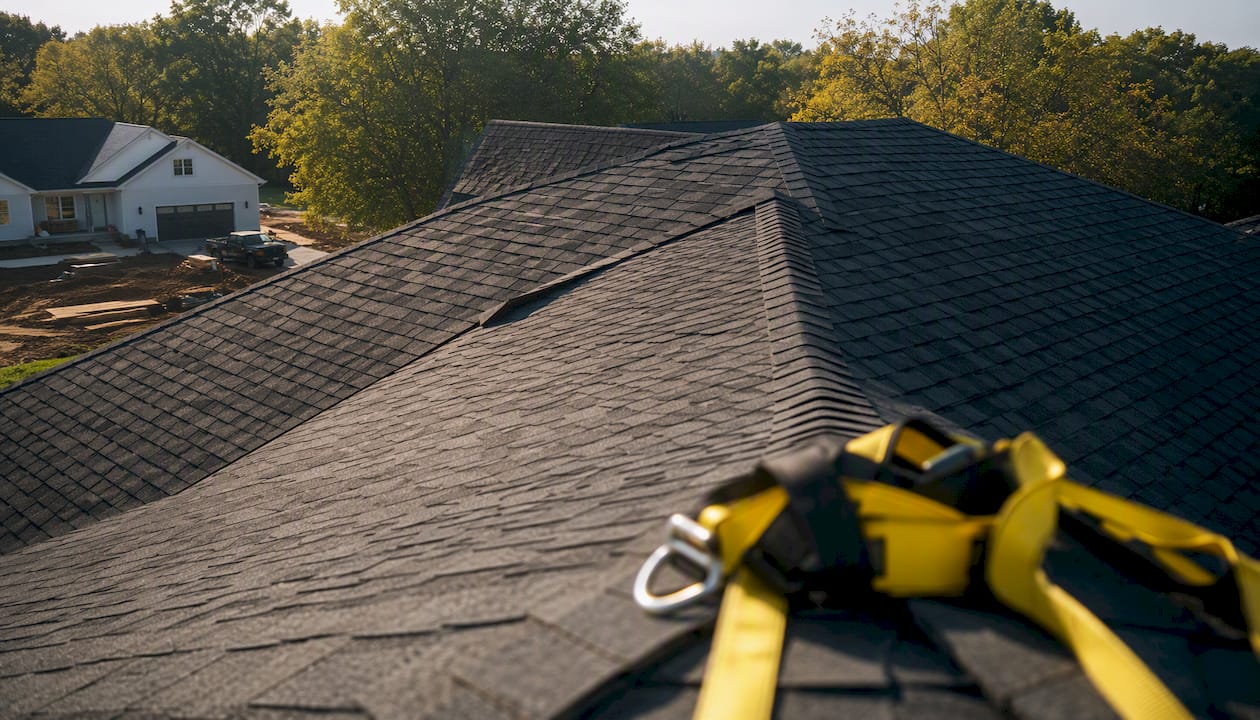
Most roofing websites lose leads before the homeowner even reaches a contact form. Mobile-first design is non-negotiable given how many storm-damage searches happen on a phone standing in a driveway. Finished-roof photos build trust faster than any amount of copy, click-to-call buttons need to be visible without scrolling, and separate service pages for each town you cover help both search rankings and visitor confidence that you actually work in their area.
The single highest-leverage addition is an instant estimator or quote widget. Homeowners exchange contact details far more readily when they get a price range in return, which is why estimator tools consistently outperform standard contact forms for conversion rate. The order you ask for information matters too: lead with something low-friction (postcode, roof type) before asking for phone and email, and save permission-to-call consent for the final step once they’re invested.
Capture these fields, in this order, for the cleanest funnel:
Property address or postcode
Roof type and rough size (or a photo upload)
Urgency (leak, storm damage, planned replacement)
Name and phone number
Email and permission to call
What to measure | Why it matters |
|---|---|
Conversion rate | Tells you if the page or widget is actually working |
Lead-to-booked-job rate | Separates a good page from a page full of tyre-kickers |
Time-to-first-contact | Directly predicts whether you’ll close the lead |
Lead source attribution | Shows which channel is actually paying for itself |
Wire your estimator to your CRM through a webhook so every submission auto-creates a job record and tags its source. A conversion-focused website build that handles this properly removes the manual data entry that causes leads to go cold overnight.
How fast should you respond to a new roofing lead?
Contact a lead within five minutes and your odds of converting them jump substantially compared to waiting even 30 minutes, based on Roofr’s analysis of roofing lead behaviour. Homeowners comparing quotes call whoever answers first, and most stop looking once they’ve booked an inspection.
A simple workflow gets you there without hiring extra staff:
Instant SMS acknowledgement fires the moment the form or estimator submits.
An automated itemised estimate follows within minutes, based on the property details captured.
A same-day inspection booking link goes out if the lead hasn’t converted to a call.
A formal quote follows within 24 to 48 hours of the inspection.
Before routing a lead to a crew, run a quick qualification check: is this urgent (active leak, storm damage) or planned (ageing roof, renovation)? Urgent leads go straight to whoever’s closest and available; planned leads can sit in a nurture sequence for a day or two.
Track three numbers weekly: average response time, lead-to-inspection rate, and lead-to-signed-job rate. A two-person office can run this manually with phone alerts and a shared calendar. Larger teams need a CRM with automated routing so leads don’t sit in an inbox waiting for someone to notice.
How do referrals and reviews lower your cost per lead?
Referrals and reviews cost almost nothing per lead and close at rates paid channels rarely match, because the homeowner arrives already trusting you. The system just needs to be deliberate.
Ask for the referral at job completion, when satisfaction is highest, not weeks later.
Offer a simple reward (a gift card, a discount on future work) and track referrals through your CRM.
Thank referrers within 48 hours; a quick text beats a delayed email every time.
Request Google reviews the same day you finish a job, with a direct link, not a generic “leave us a review” message.
Local outreach rounds this out. Neighbourhood Facebook groups, property manager partnerships, and real estate agent relationships all generate warm introductions rather than cold leads. Storm-response outreach works, but knock on doors to offer inspections, not to pressure a decision on the spot; that reputation follows you.
Pro Tip: A yard sign on a finished job, paired with a photo follow-up and a one-tap review link, does more for local visibility than most paid ads costing ten times as much.
What role does AI play in roofing lead generation?
AI earns its place in a few specific spots: instant estimator widgets, SMS and email autoresponders, and CRM tagging that scores leads by urgency and likely value. A well-configured AI system can capture a lead’s details on your website at 11pm, send a preliminary estimate, and flag it as urgent, all before your team opens up in the morning.
Where it gets risky is pricing. AI-generated estimates need a human check before they go out as a final quote. Weather, roof condition, and material access vary too much for an algorithm to get right every time. Ad targeting also has platform-specific compliance limits worth checking before you automate spend decisions entirely.
Keep a short checklist: define what AI handles alone versus what needs a human sign-off, review automated quotes weekly for accuracy, and track customer satisfaction on AI-touched leads separately from human-handled ones.
How much should you budget for roofing leads?
Work out cost per booked job, not cost per lead, before committing real budget anywhere.
Paid channels like Local Services Ads and Google Ads typically carry higher cost per lead than organic channels, but they deliver volume faster. SimplyWise’s research confirms organic and referral channels remain the most cost-effective over time, while paid channels exist to fill immediate gaps in your pipeline.
Set a test budget with a fixed measurement window (four to six weeks minimum), a minimum sample size before judging results, and a stop-loss rule if cost per booked job blows out past what a job is worth. Storm season changes the maths entirely: demand spikes suddenly, and contractors ready with fast, accurate quotes capture a disproportionate share of that surge. Reweight budget toward speed and capacity during those windows, then scale back to your steady-state mix once things settle.
How do you choose a roofing lead-generation partner?
Vet any agency or lead provider against a short checklist before signing anything:
Reporting cadence: do you get weekly or monthly numbers, and can you see raw lead data?
Lead ownership: are leads exclusively yours, or resold to competitors in your area?
Territory exclusivity: does the provider guarantee one client per service area?
Verification steps: how are leads screened for bots and genuine homeowner intent?
Refund or replacement policy: what happens with a bad or fake lead?
Watch for red flags: leads resold to multiple contractors without disclosure, no source attribution on what you’re paying for, or a long onboarding period with no early wins to show it’s working.
Ask directly: how do you verify a lead is real? What’s the typical cost per lead and conversion-to-booked-job rate for roofing clients specifically? Can you integrate with our existing CRM without a rebuild?
When comparing offers, use consistent dimensions rather than picking on price alone:
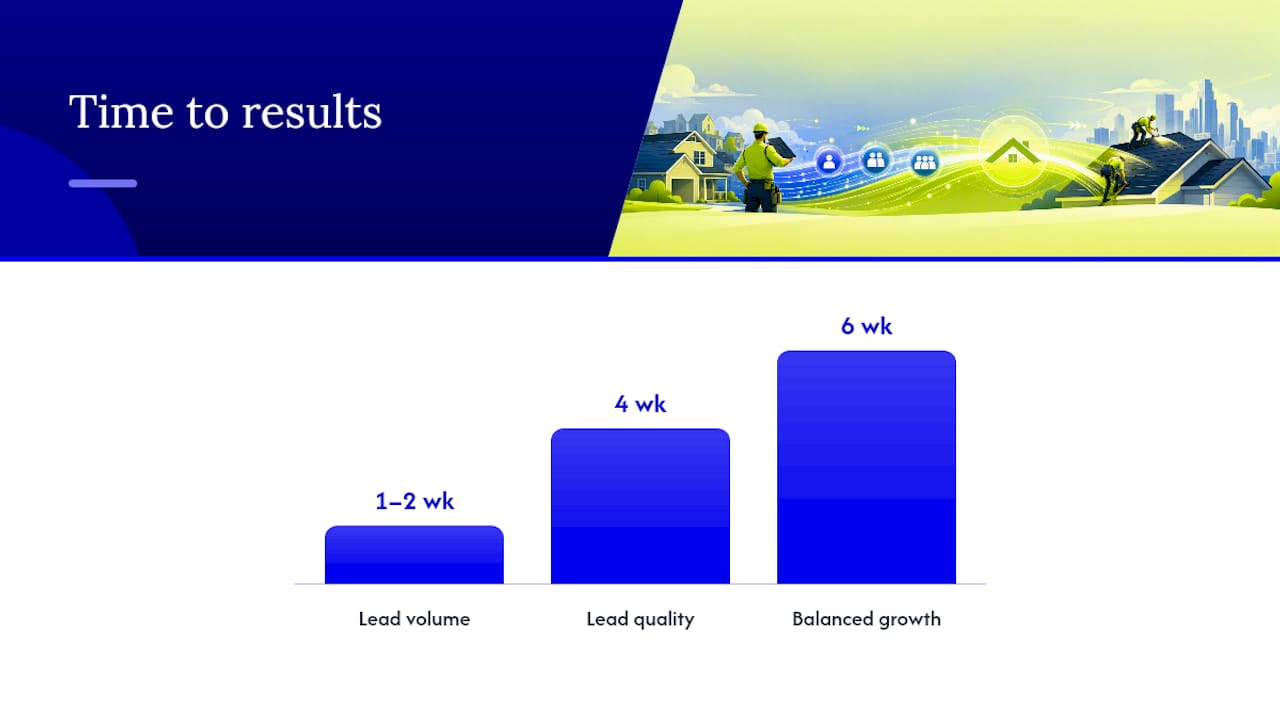
Best for | Typical CPL | Time to results | Effort required | What’s delivered |
|---|---|---|---|---|
Lead quality | Higher | 4 weeks | Managed | Exclusive, verified leads |
Lead volume | Lower | 1 to 2 weeks | In-house heavy | Shared or unverified leads |
Balanced growth | Mid-range | 6 weeks | Managed with reporting | Exclusive leads plus booking support |
Pro Tip: If a provider can’t explain their verification process in one clear sentence, that’s the answer.
What does a real roofing lead-generation result look like?
Sun State Digital worked with Ray White Aspley to rebuild their local search presence and lead capture setup from the ground up, combining Google Business Profile optimisation, a conversion-focused website rebuild, and tighter ad targeting.
The result: lead costs cut significantly while lead quality improved, tracked across three metrics throughout the engagement:
Cost per lead (down from the prior baseline)
Conversion rate from enquiry to booked appointment
Time-to-first-quote after initial contact
The full breakdown, including the channels used and the reporting approach, sits in the Ray White Aspley case study.
What should your first 90 days actually look like?
Month one: claim and fully optimise your Google Business Profile, launch a conversion-focused landing page with an estimator, and set up basic reporting. Month two: launch one paid channel, build out automated response workflows, and start actively requesting reviews. Month three: scale whatever channel shows the best cost per booked job, formalise your referral partnerships, and fix whatever bottleneck the data reveals. Don’t skip the reporting step to save time early. Without it, you won’t know what’s actually working by month three.
Ready to fix your roofing lead pipeline?
Sun State Digital gives roofers a faster path to booked jobs than piecing together your own stack of tools and freelancers. Instead of juggling separate people for your website, your Google Business Profile, your ads, and your follow-up automation, you get one team building all of it as a single connected system, which is exactly the setup behind the Ray White Aspley result above.
A Sun State Digital audit covers your local search health, the conversion blockers on your current website, and the quick wins available before you spend another dollar on ads. We build this around SEO and local search optimisation, Google Ads management, and CRM automation that handles your speed-to-lead follow-up automatically. Book a discovery session through Sun State Digital to get your audit started this week.
Frequently asked questions
What is the fastest way to generate roofing leads right now? Claim your Google Business Profile, add an instant estimator to your website, and run one paid channel while you tighten response times. This combination produces results faster than any single tactic alone.
How much does roofing lead generation typically cost? It varies by channel and market, but the better question is cost per booked job. A cheaper lead that closes poorly can cost more overall than a pricier, well-qualified one.
How long does it take to see results from roofing lead generation? Paid channels can produce leads within one to two weeks. Organic channels like local SEO and reviews typically take six to twelve weeks to build meaningful volume.
Is Facebook advertising worth it for roofing leads? Geo-targeted social ads work well for awareness and retargeting website visitors, but they generally convert at a lower rate than search-based channels where homeowners are already looking for a roofer.
What’s the biggest mistake roofers make with lead generation? Slow response time. A lead sitting unanswered for even 30 minutes converts at a fraction of the rate of one contacted within five minutes.
Sources
How to Get Roofing Leads: Trends, Challenges, and Proven Strategies | Eagleview
How to Generate More Roofing Leads in 2026: 15+ Proven Strategies | Roofr
Roofing Leads: 10 Sources That Book Jobs in 2026 | SimplyWise
Recommended
Stay Inspired
Get fresh design insights, articles, and resources delivered straight to your inbox.
Latest Blogs



Stay Inspired
Get fresh design insights, articles, and resources delivered straight to your inbox.
Insights
Aug 16, 2026
Roofing lead generation: proven strategies for 2026
Roofing lead generation: proven strategies for 2026
Discover proven strategies for roofing lead generation in 2026. Optimize your search presence, enhance your website, and capture high-quality leads!
Discover proven strategies for roofing lead generation in 2026. Optimize your search presence, enhance your website, and capture high-quality leads!
Roofing lead generation: proven strategies for 2026
The fastest way to build consistent, high-quality roofing leads is a three-part system: a fully optimised local search presence, a website that captures leads with an instant estimator, and one paid channel running while you tighten your speed-to-lead process. This combination wins because it stacks high-intent traffic from your Google Business Profile and Local Services Ads with the conversion lift of instant quoting tools and fast follow-up, rather than relying on any single tactic.
Here’s what to do in week one:
Claim and fully verify your Google Business Profile with real job photos.
Add click-to-call and instant estimate widgets to every service page.
Set up automated SMS acknowledgement for every new enquiry.
Pick one paid channel (Local Services Ads or Google Ads) and commit a test budget.
Roofers who respond within five minutes of a lead landing convert at dramatically higher rates than those who wait even an hour, according to Roofr’s 2026 lead generation research. Speed is not a nice extra here. It is the difference between winning the job and funding a competitor’s marketing budget.
Pro Tip: Don’t launch five channels in week one. Get your Google Business Profile verified and your estimator widget live first. Everything else builds on that foundation.
Key Takeaways
Consistent, high-quality roofing leads come from stacking a fully optimised local search presence with an instant-estimator website and one well-managed paid channel, backed by a five-minute response workflow.
Point | Details |
|---|---|
Start with organic foundations | Claim and verify Google Business Profile before spending on paid channels. |
Add one paid channel at a time | Test Local Services Ads or Google Ads and measure cost per booked job. |
Build instant capture into your site | Install an estimator widget and capture data fields in the right order. |
Respond within five minutes | Automate SMS acknowledgement and quoting to win jobs before competitors call back. |
Vet partners on transparency | Choose a provider like Sun State Digital that reports clearly and guarantees territory exclusivity. |
Table of Contents
What channels actually generate roofing leads?
Which website features turn clicks into booked jobs?
How fast should you respond to a new roofing lead?
How do referrals and reviews lower your cost per lead?
What role does AI play in roofing lead generation?
How much should you budget for roofing leads?
How do you choose a roofing lead-generation partner?
What does a real roofing lead-generation result look like?
What should your first 90 days actually look like?
Ready to fix your roofing lead pipeline?
Frequently asked questions
Sources
What channels actually generate roofing leads?
Start with the channels that compound before you spend a dollar on ads. Your Google Business Profile, loaded with finished-job photos and a steady stream of reviews, drives the “roofer near me” searches that convert at the highest rate because the homeowner is already looking for exactly what you do. Local content, referrals, and a well-optimised website round out this free tier. None of it is instant, but all of it keeps paying you back long after you stop actively working on it.
Paid channels fill the gap while your organic presence builds. Local Services Ads (LSAs) put you in front of homeowners with a “Google Screened” badge and pay-per-lead pricing, which tends to suit smaller teams testing their first paid channel. Search ads through Google Ads give you more control over keywords and landing pages but require tighter management. Geo-targeted social ads work well for brand awareness and retargeting website visitors, though they rarely produce the same intent-to-call rate as search-based channels.
Then there’s the gap-fill tier: verified-call providers and lead marketplaces. Providers using OTP verification and bot detection can screen out junk leads before they ever hit your phone, according to Elevarus, which makes them useful when you need volume fast. Treat these as a stop-gap, not your foundation. They cost more per lead over time and don’t build any asset you own.
Judge every channel by cost per booked job, not cost per lead. Test one paid channel at a time so you actually know what’s working.
Pro Tip: Pick four channels for the season, one compounding (GBP or reviews), one capture (your website), one paid (LSAs or search ads), and one outreach (referrals or local partnerships), and run them consistently rather than chasing whatever’s trending this month. SimplyWise’s research backs this “pick four and commit” approach as the most reliable operational rule for roofing lead sources.
Which website features turn clicks into booked jobs?
Most roofing websites lose leads before the homeowner even reaches a contact form. Mobile-first design is non-negotiable given how many storm-damage searches happen on a phone standing in a driveway. Finished-roof photos build trust faster than any amount of copy, click-to-call buttons need to be visible without scrolling, and separate service pages for each town you cover help both search rankings and visitor confidence that you actually work in their area.
The single highest-leverage addition is an instant estimator or quote widget. Homeowners exchange contact details far more readily when they get a price range in return, which is why estimator tools consistently outperform standard contact forms for conversion rate. The order you ask for information matters too: lead with something low-friction (postcode, roof type) before asking for phone and email, and save permission-to-call consent for the final step once they’re invested.
Capture these fields, in this order, for the cleanest funnel:
Property address or postcode
Roof type and rough size (or a photo upload)
Urgency (leak, storm damage, planned replacement)
Name and phone number
Email and permission to call
What to measure | Why it matters |
|---|---|
Conversion rate | Tells you if the page or widget is actually working |
Lead-to-booked-job rate | Separates a good page from a page full of tyre-kickers |
Time-to-first-contact | Directly predicts whether you’ll close the lead |
Lead source attribution | Shows which channel is actually paying for itself |
Wire your estimator to your CRM through a webhook so every submission auto-creates a job record and tags its source. A conversion-focused website build that handles this properly removes the manual data entry that causes leads to go cold overnight.
How fast should you respond to a new roofing lead?
Contact a lead within five minutes and your odds of converting them jump substantially compared to waiting even 30 minutes, based on Roofr’s analysis of roofing lead behaviour. Homeowners comparing quotes call whoever answers first, and most stop looking once they’ve booked an inspection.
A simple workflow gets you there without hiring extra staff:
Instant SMS acknowledgement fires the moment the form or estimator submits.
An automated itemised estimate follows within minutes, based on the property details captured.
A same-day inspection booking link goes out if the lead hasn’t converted to a call.
A formal quote follows within 24 to 48 hours of the inspection.
Before routing a lead to a crew, run a quick qualification check: is this urgent (active leak, storm damage) or planned (ageing roof, renovation)? Urgent leads go straight to whoever’s closest and available; planned leads can sit in a nurture sequence for a day or two.
Track three numbers weekly: average response time, lead-to-inspection rate, and lead-to-signed-job rate. A two-person office can run this manually with phone alerts and a shared calendar. Larger teams need a CRM with automated routing so leads don’t sit in an inbox waiting for someone to notice.
How do referrals and reviews lower your cost per lead?
Referrals and reviews cost almost nothing per lead and close at rates paid channels rarely match, because the homeowner arrives already trusting you. The system just needs to be deliberate.
Ask for the referral at job completion, when satisfaction is highest, not weeks later.
Offer a simple reward (a gift card, a discount on future work) and track referrals through your CRM.
Thank referrers within 48 hours; a quick text beats a delayed email every time.
Request Google reviews the same day you finish a job, with a direct link, not a generic “leave us a review” message.
Local outreach rounds this out. Neighbourhood Facebook groups, property manager partnerships, and real estate agent relationships all generate warm introductions rather than cold leads. Storm-response outreach works, but knock on doors to offer inspections, not to pressure a decision on the spot; that reputation follows you.
Pro Tip: A yard sign on a finished job, paired with a photo follow-up and a one-tap review link, does more for local visibility than most paid ads costing ten times as much.
What role does AI play in roofing lead generation?
AI earns its place in a few specific spots: instant estimator widgets, SMS and email autoresponders, and CRM tagging that scores leads by urgency and likely value. A well-configured AI system can capture a lead’s details on your website at 11pm, send a preliminary estimate, and flag it as urgent, all before your team opens up in the morning.
Where it gets risky is pricing. AI-generated estimates need a human check before they go out as a final quote. Weather, roof condition, and material access vary too much for an algorithm to get right every time. Ad targeting also has platform-specific compliance limits worth checking before you automate spend decisions entirely.
Keep a short checklist: define what AI handles alone versus what needs a human sign-off, review automated quotes weekly for accuracy, and track customer satisfaction on AI-touched leads separately from human-handled ones.
How much should you budget for roofing leads?
Work out cost per booked job, not cost per lead, before committing real budget anywhere.
Paid channels like Local Services Ads and Google Ads typically carry higher cost per lead than organic channels, but they deliver volume faster. SimplyWise’s research confirms organic and referral channels remain the most cost-effective over time, while paid channels exist to fill immediate gaps in your pipeline.
Set a test budget with a fixed measurement window (four to six weeks minimum), a minimum sample size before judging results, and a stop-loss rule if cost per booked job blows out past what a job is worth. Storm season changes the maths entirely: demand spikes suddenly, and contractors ready with fast, accurate quotes capture a disproportionate share of that surge. Reweight budget toward speed and capacity during those windows, then scale back to your steady-state mix once things settle.
How do you choose a roofing lead-generation partner?
Vet any agency or lead provider against a short checklist before signing anything:
Reporting cadence: do you get weekly or monthly numbers, and can you see raw lead data?
Lead ownership: are leads exclusively yours, or resold to competitors in your area?
Territory exclusivity: does the provider guarantee one client per service area?
Verification steps: how are leads screened for bots and genuine homeowner intent?
Refund or replacement policy: what happens with a bad or fake lead?
Watch for red flags: leads resold to multiple contractors without disclosure, no source attribution on what you’re paying for, or a long onboarding period with no early wins to show it’s working.
Ask directly: how do you verify a lead is real? What’s the typical cost per lead and conversion-to-booked-job rate for roofing clients specifically? Can you integrate with our existing CRM without a rebuild?
When comparing offers, use consistent dimensions rather than picking on price alone:
Best for | Typical CPL | Time to results | Effort required | What’s delivered |
|---|---|---|---|---|
Lead quality | Higher | 4 weeks | Managed | Exclusive, verified leads |
Lead volume | Lower | 1 to 2 weeks | In-house heavy | Shared or unverified leads |
Balanced growth | Mid-range | 6 weeks | Managed with reporting | Exclusive leads plus booking support |
Pro Tip: If a provider can’t explain their verification process in one clear sentence, that’s the answer.
What does a real roofing lead-generation result look like?
Sun State Digital worked with Ray White Aspley to rebuild their local search presence and lead capture setup from the ground up, combining Google Business Profile optimisation, a conversion-focused website rebuild, and tighter ad targeting.
The result: lead costs cut significantly while lead quality improved, tracked across three metrics throughout the engagement:
Cost per lead (down from the prior baseline)
Conversion rate from enquiry to booked appointment
Time-to-first-quote after initial contact
The full breakdown, including the channels used and the reporting approach, sits in the Ray White Aspley case study.
What should your first 90 days actually look like?
Month one: claim and fully optimise your Google Business Profile, launch a conversion-focused landing page with an estimator, and set up basic reporting. Month two: launch one paid channel, build out automated response workflows, and start actively requesting reviews. Month three: scale whatever channel shows the best cost per booked job, formalise your referral partnerships, and fix whatever bottleneck the data reveals. Don’t skip the reporting step to save time early. Without it, you won’t know what’s actually working by month three.
Ready to fix your roofing lead pipeline?
Sun State Digital gives roofers a faster path to booked jobs than piecing together your own stack of tools and freelancers. Instead of juggling separate people for your website, your Google Business Profile, your ads, and your follow-up automation, you get one team building all of it as a single connected system, which is exactly the setup behind the Ray White Aspley result above.
A Sun State Digital audit covers your local search health, the conversion blockers on your current website, and the quick wins available before you spend another dollar on ads. We build this around SEO and local search optimisation, Google Ads management, and CRM automation that handles your speed-to-lead follow-up automatically. Book a discovery session through Sun State Digital to get your audit started this week.
Frequently asked questions
What is the fastest way to generate roofing leads right now? Claim your Google Business Profile, add an instant estimator to your website, and run one paid channel while you tighten response times. This combination produces results faster than any single tactic alone.
How much does roofing lead generation typically cost? It varies by channel and market, but the better question is cost per booked job. A cheaper lead that closes poorly can cost more overall than a pricier, well-qualified one.
How long does it take to see results from roofing lead generation? Paid channels can produce leads within one to two weeks. Organic channels like local SEO and reviews typically take six to twelve weeks to build meaningful volume.
Is Facebook advertising worth it for roofing leads? Geo-targeted social ads work well for awareness and retargeting website visitors, but they generally convert at a lower rate than search-based channels where homeowners are already looking for a roofer.
What’s the biggest mistake roofers make with lead generation? Slow response time. A lead sitting unanswered for even 30 minutes converts at a fraction of the rate of one contacted within five minutes.
Sources
How to Get Roofing Leads: Trends, Challenges, and Proven Strategies | Eagleview
How to Generate More Roofing Leads in 2026: 15+ Proven Strategies | Roofr
Roofing Leads: 10 Sources That Book Jobs in 2026 | SimplyWise
Recommended
Stay Inspired
Get fresh design insights, articles, and resources delivered straight to your inbox.
Latest Blogs
Stay Inspired
Get fresh design insights, articles, and resources delivered straight to your inbox.
Insights
Aug 16, 2026
Roofing lead generation: proven strategies for 2026
Roofing lead generation: proven strategies for 2026
Discover proven strategies for roofing lead generation in 2026. Optimize your search presence, enhance your website, and capture high-quality leads!
Discover proven strategies for roofing lead generation in 2026. Optimize your search presence, enhance your website, and capture high-quality leads!
Roofing lead generation: proven strategies for 2026
The fastest way to build consistent, high-quality roofing leads is a three-part system: a fully optimised local search presence, a website that captures leads with an instant estimator, and one paid channel running while you tighten your speed-to-lead process. This combination wins because it stacks high-intent traffic from your Google Business Profile and Local Services Ads with the conversion lift of instant quoting tools and fast follow-up, rather than relying on any single tactic.
Here’s what to do in week one:
Claim and fully verify your Google Business Profile with real job photos.
Add click-to-call and instant estimate widgets to every service page.
Set up automated SMS acknowledgement for every new enquiry.
Pick one paid channel (Local Services Ads or Google Ads) and commit a test budget.
Roofers who respond within five minutes of a lead landing convert at dramatically higher rates than those who wait even an hour, according to Roofr’s 2026 lead generation research. Speed is not a nice extra here. It is the difference between winning the job and funding a competitor’s marketing budget.
Pro Tip: Don’t launch five channels in week one. Get your Google Business Profile verified and your estimator widget live first. Everything else builds on that foundation.
Key Takeaways
Consistent, high-quality roofing leads come from stacking a fully optimised local search presence with an instant-estimator website and one well-managed paid channel, backed by a five-minute response workflow.
Point | Details |
|---|---|
Start with organic foundations | Claim and verify Google Business Profile before spending on paid channels. |
Add one paid channel at a time | Test Local Services Ads or Google Ads and measure cost per booked job. |
Build instant capture into your site | Install an estimator widget and capture data fields in the right order. |
Respond within five minutes | Automate SMS acknowledgement and quoting to win jobs before competitors call back. |
Vet partners on transparency | Choose a provider like Sun State Digital that reports clearly and guarantees territory exclusivity. |
Table of Contents
What channels actually generate roofing leads?
Which website features turn clicks into booked jobs?
How fast should you respond to a new roofing lead?
How do referrals and reviews lower your cost per lead?
What role does AI play in roofing lead generation?
How much should you budget for roofing leads?
How do you choose a roofing lead-generation partner?
What does a real roofing lead-generation result look like?
What should your first 90 days actually look like?
Ready to fix your roofing lead pipeline?
Frequently asked questions
Sources
What channels actually generate roofing leads?
Start with the channels that compound before you spend a dollar on ads. Your Google Business Profile, loaded with finished-job photos and a steady stream of reviews, drives the “roofer near me” searches that convert at the highest rate because the homeowner is already looking for exactly what you do. Local content, referrals, and a well-optimised website round out this free tier. None of it is instant, but all of it keeps paying you back long after you stop actively working on it.
Paid channels fill the gap while your organic presence builds. Local Services Ads (LSAs) put you in front of homeowners with a “Google Screened” badge and pay-per-lead pricing, which tends to suit smaller teams testing their first paid channel. Search ads through Google Ads give you more control over keywords and landing pages but require tighter management. Geo-targeted social ads work well for brand awareness and retargeting website visitors, though they rarely produce the same intent-to-call rate as search-based channels.
Then there’s the gap-fill tier: verified-call providers and lead marketplaces. Providers using OTP verification and bot detection can screen out junk leads before they ever hit your phone, according to Elevarus, which makes them useful when you need volume fast. Treat these as a stop-gap, not your foundation. They cost more per lead over time and don’t build any asset you own.
Judge every channel by cost per booked job, not cost per lead. Test one paid channel at a time so you actually know what’s working.
Pro Tip: Pick four channels for the season, one compounding (GBP or reviews), one capture (your website), one paid (LSAs or search ads), and one outreach (referrals or local partnerships), and run them consistently rather than chasing whatever’s trending this month. SimplyWise’s research backs this “pick four and commit” approach as the most reliable operational rule for roofing lead sources.
Which website features turn clicks into booked jobs?
Most roofing websites lose leads before the homeowner even reaches a contact form. Mobile-first design is non-negotiable given how many storm-damage searches happen on a phone standing in a driveway. Finished-roof photos build trust faster than any amount of copy, click-to-call buttons need to be visible without scrolling, and separate service pages for each town you cover help both search rankings and visitor confidence that you actually work in their area.
The single highest-leverage addition is an instant estimator or quote widget. Homeowners exchange contact details far more readily when they get a price range in return, which is why estimator tools consistently outperform standard contact forms for conversion rate. The order you ask for information matters too: lead with something low-friction (postcode, roof type) before asking for phone and email, and save permission-to-call consent for the final step once they’re invested.
Capture these fields, in this order, for the cleanest funnel:
Property address or postcode
Roof type and rough size (or a photo upload)
Urgency (leak, storm damage, planned replacement)
Name and phone number
Email and permission to call
What to measure | Why it matters |
|---|---|
Conversion rate | Tells you if the page or widget is actually working |
Lead-to-booked-job rate | Separates a good page from a page full of tyre-kickers |
Time-to-first-contact | Directly predicts whether you’ll close the lead |
Lead source attribution | Shows which channel is actually paying for itself |
Wire your estimator to your CRM through a webhook so every submission auto-creates a job record and tags its source. A conversion-focused website build that handles this properly removes the manual data entry that causes leads to go cold overnight.
How fast should you respond to a new roofing lead?
Contact a lead within five minutes and your odds of converting them jump substantially compared to waiting even 30 minutes, based on Roofr’s analysis of roofing lead behaviour. Homeowners comparing quotes call whoever answers first, and most stop looking once they’ve booked an inspection.
A simple workflow gets you there without hiring extra staff:
Instant SMS acknowledgement fires the moment the form or estimator submits.
An automated itemised estimate follows within minutes, based on the property details captured.
A same-day inspection booking link goes out if the lead hasn’t converted to a call.
A formal quote follows within 24 to 48 hours of the inspection.
Before routing a lead to a crew, run a quick qualification check: is this urgent (active leak, storm damage) or planned (ageing roof, renovation)? Urgent leads go straight to whoever’s closest and available; planned leads can sit in a nurture sequence for a day or two.
Track three numbers weekly: average response time, lead-to-inspection rate, and lead-to-signed-job rate. A two-person office can run this manually with phone alerts and a shared calendar. Larger teams need a CRM with automated routing so leads don’t sit in an inbox waiting for someone to notice.
How do referrals and reviews lower your cost per lead?
Referrals and reviews cost almost nothing per lead and close at rates paid channels rarely match, because the homeowner arrives already trusting you. The system just needs to be deliberate.
Ask for the referral at job completion, when satisfaction is highest, not weeks later.
Offer a simple reward (a gift card, a discount on future work) and track referrals through your CRM.
Thank referrers within 48 hours; a quick text beats a delayed email every time.
Request Google reviews the same day you finish a job, with a direct link, not a generic “leave us a review” message.
Local outreach rounds this out. Neighbourhood Facebook groups, property manager partnerships, and real estate agent relationships all generate warm introductions rather than cold leads. Storm-response outreach works, but knock on doors to offer inspections, not to pressure a decision on the spot; that reputation follows you.
Pro Tip: A yard sign on a finished job, paired with a photo follow-up and a one-tap review link, does more for local visibility than most paid ads costing ten times as much.
What role does AI play in roofing lead generation?
AI earns its place in a few specific spots: instant estimator widgets, SMS and email autoresponders, and CRM tagging that scores leads by urgency and likely value. A well-configured AI system can capture a lead’s details on your website at 11pm, send a preliminary estimate, and flag it as urgent, all before your team opens up in the morning.
Where it gets risky is pricing. AI-generated estimates need a human check before they go out as a final quote. Weather, roof condition, and material access vary too much for an algorithm to get right every time. Ad targeting also has platform-specific compliance limits worth checking before you automate spend decisions entirely.
Keep a short checklist: define what AI handles alone versus what needs a human sign-off, review automated quotes weekly for accuracy, and track customer satisfaction on AI-touched leads separately from human-handled ones.
How much should you budget for roofing leads?
Work out cost per booked job, not cost per lead, before committing real budget anywhere.
Paid channels like Local Services Ads and Google Ads typically carry higher cost per lead than organic channels, but they deliver volume faster. SimplyWise’s research confirms organic and referral channels remain the most cost-effective over time, while paid channels exist to fill immediate gaps in your pipeline.
Set a test budget with a fixed measurement window (four to six weeks minimum), a minimum sample size before judging results, and a stop-loss rule if cost per booked job blows out past what a job is worth. Storm season changes the maths entirely: demand spikes suddenly, and contractors ready with fast, accurate quotes capture a disproportionate share of that surge. Reweight budget toward speed and capacity during those windows, then scale back to your steady-state mix once things settle.
How do you choose a roofing lead-generation partner?
Vet any agency or lead provider against a short checklist before signing anything:
Reporting cadence: do you get weekly or monthly numbers, and can you see raw lead data?
Lead ownership: are leads exclusively yours, or resold to competitors in your area?
Territory exclusivity: does the provider guarantee one client per service area?
Verification steps: how are leads screened for bots and genuine homeowner intent?
Refund or replacement policy: what happens with a bad or fake lead?
Watch for red flags: leads resold to multiple contractors without disclosure, no source attribution on what you’re paying for, or a long onboarding period with no early wins to show it’s working.
Ask directly: how do you verify a lead is real? What’s the typical cost per lead and conversion-to-booked-job rate for roofing clients specifically? Can you integrate with our existing CRM without a rebuild?
When comparing offers, use consistent dimensions rather than picking on price alone:
Best for | Typical CPL | Time to results | Effort required | What’s delivered |
|---|---|---|---|---|
Lead quality | Higher | 4 weeks | Managed | Exclusive, verified leads |
Lead volume | Lower | 1 to 2 weeks | In-house heavy | Shared or unverified leads |
Balanced growth | Mid-range | 6 weeks | Managed with reporting | Exclusive leads plus booking support |
Pro Tip: If a provider can’t explain their verification process in one clear sentence, that’s the answer.
What does a real roofing lead-generation result look like?
Sun State Digital worked with Ray White Aspley to rebuild their local search presence and lead capture setup from the ground up, combining Google Business Profile optimisation, a conversion-focused website rebuild, and tighter ad targeting.
The result: lead costs cut significantly while lead quality improved, tracked across three metrics throughout the engagement:
Cost per lead (down from the prior baseline)
Conversion rate from enquiry to booked appointment
Time-to-first-quote after initial contact
The full breakdown, including the channels used and the reporting approach, sits in the Ray White Aspley case study.
What should your first 90 days actually look like?
Month one: claim and fully optimise your Google Business Profile, launch a conversion-focused landing page with an estimator, and set up basic reporting. Month two: launch one paid channel, build out automated response workflows, and start actively requesting reviews. Month three: scale whatever channel shows the best cost per booked job, formalise your referral partnerships, and fix whatever bottleneck the data reveals. Don’t skip the reporting step to save time early. Without it, you won’t know what’s actually working by month three.
Ready to fix your roofing lead pipeline?
Sun State Digital gives roofers a faster path to booked jobs than piecing together your own stack of tools and freelancers. Instead of juggling separate people for your website, your Google Business Profile, your ads, and your follow-up automation, you get one team building all of it as a single connected system, which is exactly the setup behind the Ray White Aspley result above.
A Sun State Digital audit covers your local search health, the conversion blockers on your current website, and the quick wins available before you spend another dollar on ads. We build this around SEO and local search optimisation, Google Ads management, and CRM automation that handles your speed-to-lead follow-up automatically. Book a discovery session through Sun State Digital to get your audit started this week.
Frequently asked questions
What is the fastest way to generate roofing leads right now? Claim your Google Business Profile, add an instant estimator to your website, and run one paid channel while you tighten response times. This combination produces results faster than any single tactic alone.
How much does roofing lead generation typically cost? It varies by channel and market, but the better question is cost per booked job. A cheaper lead that closes poorly can cost more overall than a pricier, well-qualified one.
How long does it take to see results from roofing lead generation? Paid channels can produce leads within one to two weeks. Organic channels like local SEO and reviews typically take six to twelve weeks to build meaningful volume.
Is Facebook advertising worth it for roofing leads? Geo-targeted social ads work well for awareness and retargeting website visitors, but they generally convert at a lower rate than search-based channels where homeowners are already looking for a roofer.
What’s the biggest mistake roofers make with lead generation? Slow response time. A lead sitting unanswered for even 30 minutes converts at a fraction of the rate of one contacted within five minutes.
Sources
How to Get Roofing Leads: Trends, Challenges, and Proven Strategies | Eagleview
How to Generate More Roofing Leads in 2026: 15+ Proven Strategies | Roofr
Roofing Leads: 10 Sources That Book Jobs in 2026 | SimplyWise
Recommended
Stay Inspired
Get fresh design insights, articles, and resources delivered straight to your inbox.
Latest Blogs
Stay Inspired
Get fresh design insights, articles, and resources delivered straight to your inbox.