
Insights
Aug 28, 2026
Cut CPA With Creative and Tracking: Facebook Ad Costs Australia 2026
Cut CPA With Creative and Tracking: Facebook Ad Costs Australia 2026
2026 Australia benchmarks for Facebook ads: CPC AU$0.90–AU$2.50 and a rule to budget AU$1,000–AU$1,500/month. Learn the creative and tracking fixes that...
2026 Australia benchmarks for Facebook ads: CPC AU$0.90–AU$2.50 and a rule to budget AU$1,000–AU$1,500/month. Learn the creative and tracking fixes that...
Cut CPA With Creative and Tracking: Facebook Ad Costs Australia 2026
Expect to pay roughly AU$0.90 to AU$2.50 per click and AU$8 to AU$22 per thousand impressions on Facebook and Instagram in Australia this year, with the exact number swinging hard by industry and audience. The one rule that matters more than any benchmark: budget at least AU$1,000 to AU$1,500 a month, or the algorithm never gets enough data to learn who converts. Below, we discuss vertical differences and how to approach budget planning.
TL;DR:
An average Australian Facebook ad campaign costs between AU$0.90 and AU$2.50 per click, with higher costs in finance, real estate, and B2B sectors.
A monthly ad budget of at least AU$1,000 to AU$1,500 is essential for effective learning and optimization, especially for small businesses.
Creative quality, audience size, placement, and measurement accuracy are the main factors influencing ad costs and campaign performance.
Using automated bidding initially and switching to a cost cap can optimize results; a bid cap too early can hinder delivery.
Improving measurement tools and creative testing can cut costs significantly, with agencies like Sun State Digital focusing on these areas for better ROI.
Table of Contents
Facebook advertising cost Australia benchmarks by industry (2026)
How does Facebook’s ad auction actually set your price?
What actually drives your Facebook ad costs up or down?
How much should you budget for Facebook ads in Australia?
Which metrics should you track for each campaign goal?
How do placements and creative formats change your results?
What’s the fastest way to lower your Facebook ad costs?
What do Facebook ad agencies in Australia typically charge?
What happened when Sun State Digital rebuilt Ray White Aspley’s campaigns?
How does Facebook ads billing work for Australian advertisers?
What legal and compliance rules affect ad costs in Australia?
Why Australian marketers need to rethink their 2026 ad budgets
How Sun State Digital helps you cut Facebook ad costs, not just manage spend
Sources
Facebook advertising cost Australia benchmarks by industry (2026)
Blended figures across the Australian market sit at roughly AU$0.90 to AU$2.50 per click and AU$8 to AU$22 per thousand impressions, according to industry benchmarking for 2026. One dataset-style breakdown pegs the average closer to AU$0.94 CPC and AU$12.07 CPM when you blend placements and objectives together, which lands comfortably inside that wider range.
Those numbers are a starting point, not a promise. Facebook’s auction prices every advertiser against every other advertiser chasing the same eyeballs at the same moment, and some industries pay a premium for a reason we will get to in the next section.
Here is how the major Australian verticals typically stack up:
Ecommerce and retail: CPC around AU$0.80 to AU$1.80, CPM AU$10 to AU$18, CPA often AU$25 to AU$60 depending on average order value.
Food and beverage: CPC AU$0.60 to AU$1.50, CPM AU$8 to AU$15, with strong performance from local radius targeting around venues.
Fashion and beauty: CPC AU$0.70 to AU$1.60, CPM AU$9 to AU$17, heavily reliant on catalogue and video creative.
Home services and trades: CPL (cost per lead) AU$20 to AU$70, CPC AU$1.20 to AU$2.50, pricier because leads are high intent and competition is local and concentrated.
Real estate: CPC AU$1.00 to AU$2.20, CPM often AU$15 to AU$22, with cost per qualified enquiry ranging widely by suburb and property price point.
Finance and insurance: Among the most expensive categories, with CPC frequently above AU$2.00 and CPL sometimes exceeding AU$80, driven by regulatory scrutiny and high customer lifetime value.
B2B and professional services: CPC AU$1.50 to AU$3.00, CPL AU$40 to AU$150, reflecting smaller audiences and longer sales cycles.
ROAS (return on ad spend) varies just as much.
Seasonality affects costs, with CPMs generally rising in late-year retail periods and declining afterwards, so budgets should account for these typical fluctuations.
For a spreadsheet you can copy today, jot down these three figures for your vertical: your expected CPC, your expected CPM, and your target CPA. Everything else in your budget model flows from those three numbers.
How does Facebook’s ad auction actually set your price?
Facebook doesn’t sell impressions to the highest bidder. It runs an auction where your bid, your ad’s estimated action rate, and your ad’s quality score combine into a “total value” score, and the highest total value wins the placement, not the highest dollar figure. Meta’s own guidance on budgets and auction basics confirms this: a lower bid with stronger predicted engagement can beat a higher bid attached to a mediocre ad.
Predicted conversion value sits at the centre of this. Facebook estimates, in real time, how likely a specific person is to complete your chosen action, whether that’s a purchase, a lead form, or a video view. That’s why the same audience can cost wildly different amounts depending on what you’re optimising for. Optimising for purchases when you have a well-tuned pixel usually costs more per impression than optimising for traffic, because Facebook is chasing a rarer, more valuable action.
This explains why finance and real estate pay more than food and beverage. It isn’t punishment; it’s economics. Every finance brand in Australia is bidding for the same slice of high income, high intent audience, and the platform’s own scale amplifies that competition. With close to three billion monthly active users globally, demand for the best inventory never really lets up.
Your bidding strategy changes the effective cost too. Consider the trade-offs:
Automated bidding (highest volume): Lets Facebook chase the most results for your budget, usually the best starting point for new advertisers with limited data.
Cost cap: Sets a target average cost per result, useful once you know your break-even CPA and want to hold the line as you scale.
Bid cap: Sets a maximum for the auction bid itself, giving you tight control but risking underdelivery if you set it too conservatively.
ROAS goal: Available on purchase campaigns with enough conversion volume, and generally the strongest lever once you have 30 to 50 conversions a week feeding the algorithm.
For most Australian small businesses, starting broad on automated bidding and moving to a cost cap once you have a stable CPA is the more forgiving path. Locking in a bid cap too early, before Facebook has learned your audience, usually just starves your delivery.
What actually drives your Facebook ad costs up or down?
Four levers move your price more than anything else: audience size, creative quality, placement mix, and measurement accuracy. Get these right and your CPA can fall by half without touching your budget.
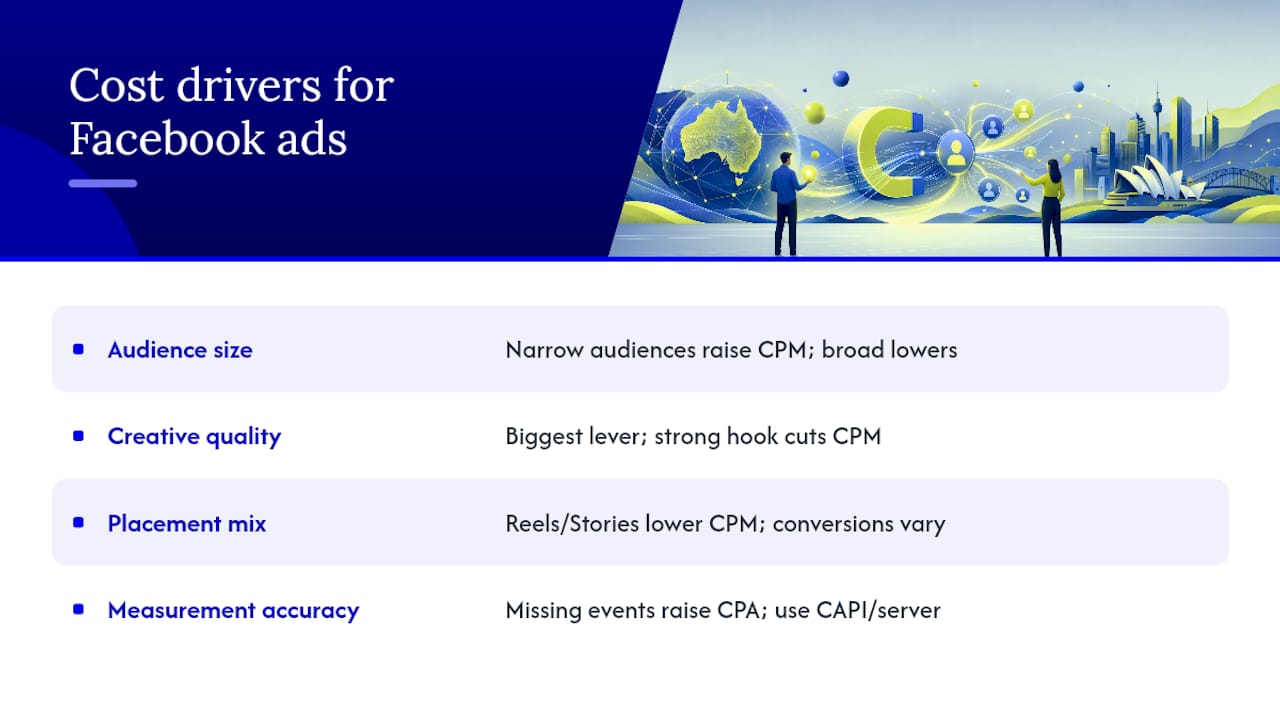
Audience size has an inverse relationship with CPM in most cases. Narrow an audience down to a tight interest stack of 50,000 people and you’ll often pay more per impression, because you’re asking the algorithm to find the same rare person again and again. Broader audiences, especially with Advantage+ audience expansion switched on, tend to find cheaper impressions because Facebook has more room to hunt for value.
Creative quality is the single biggest cost lever in 2026, arguably bigger than targeting. Facebook’s system rewards ads that people engage with by charging less to show them, which means a genuinely good hook, a strong first three seconds of video, or a thumbnail that stops the scroll can cut your CPM more than any audience tweak. Background from Australian benchmark analysis and agency playbooks consistently flags creative and measurement as the primary drivers of cost pressure heading into 2026, ahead of bidding tactics.
Placement matters because not all inventory is priced the same. Reels and Stories often carry lower CPMs than main feed simply because there’s more unsold inventory there, but conversion rates can differ too, so cheaper isn’t always cheaper per result.
Measurement quality decides whether Facebook can even learn properly. If your pixel is missing events, or you’re not sending server-side signals through the Conversions API, the algorithm is optimising on incomplete data, and your CPA drifts upward as a result. A tool like TrackAff exists specifically to fix this server-side gap for Australian advertisers who’ve lost tracking accuracy to browser privacy changes.
Narrow targeting is only justified when your customer lifetime value is high enough to absorb a premium CPM, think boutique real estate or high-ticket B2B, not general retail.
Pro Tip: Rotate your cold-audience creative every 10 to 14 days, or as soon as weekly frequency in that ad set climbs past 3.5. A frequency spike in a cold audience is almost always a creative fatigue problem, not a bidding problem, and refreshing the ad usually fixes the CPM faster than adjusting the bid ever will.
How much should you budget for Facebook ads in Australia?
Anything under roughly AU$1,000 a month rarely gives the algorithm enough conversions per week to optimise properly, a threshold echoed across Australian benchmark guides for 2026. Facebook’s own delivery system needs a steady stream of results, generally at least 15 to 25 conversions a week per ad set, before it exits the learning phase and starts finding your ideal customer efficiently. Spend too little and you’re stuck restarting that learning phase every time your budget shifts.
Realistic monthly bands by business type:
Local service businesses (tradies, clinics, salons): AU$800 to AU$1,500 a month, focused on lead generation within a tight geographic radius.
Established local services with multiple locations: AU$2,000 to AU$5,000 a month, often split across lead gen and retargeting.
Small ecommerce (under $500K annual revenue): AU$1,500 to AU$4,000 a month, weighted toward prospecting with a retargeting slice of 20 to 30%.
Scaled ecommerce brands: AU$5,000 to AU$20,000+ a month, usually running Advantage+ shopping alongside dedicated retargeting and loyalty campaigns.
B2B and SaaS: AU$2,000 to AU$8,000 a month, with a longer runway needed before CPA stabilises because sales cycles stretch the feedback loop.
The modelling method is simple once you break it into steps. Start with your audience size and expected CPM, calculate how many impressions that budget buys, apply your expected click-through rate to get clicks, then apply your website’s conversion rate to get leads or sales. Divide your budget by that number and you have your real CPL or CPA.
Say you budget AU$1,500 a month with a CPM of AU$15. That buys roughly 100,000 impressions. Run that math before you commit spend, and you’ll know within a day or two whether your target is realistic or needs adjusting.
Which metrics should you track for each campaign goal?
Match your primary metric to your campaign objective, not the other way around. Chasing a low CPC on a lead generation campaign is a common mistake, because a cheap click that never converts is worse than an expensive one that does.
Here’s what each metric measures and how to calculate it:
CPC (cost per click): Total spend divided by clicks. Track this for traffic and awareness campaigns where clicks themselves are the goal.
CPM (cost per thousand impressions): Total spend divided by impressions, multiplied by 1,000. Useful for brand awareness and reach campaigns.
CPL (cost per lead): Total spend divided by number of leads captured. This is the headline number for most local service businesses.
CPA (cost per acquisition): Total spend divided by number of completed sales or sign ups. The metric that matters most for ecommerce and subscription businesses.
CVR (conversion rate): Conversions divided by clicks, expressed as a percentage. This is the bridge between your click cost and your lead or sale cost.
ROAS (return on ad spend): Revenue generated divided by ad spend. For ecommerce, this is usually the final scorecard.
At an AU$1.20 CPC, that’s a AU$1,200 budget for that single campaign. Do this calculation before setting your monthly spend, not after.
How do placements and creative formats change your results?
Reels inventory in Australia generally carries a lower CPM than main feed placement, because Meta still has more unsold Reels inventory to fill, though that gap narrows every quarter as advertiser demand catches up. Stories sit somewhere between the two, and Audience Network, Facebook’s off-platform placement, tends to be cheapest but comes with the weakest average conversion quality for most Australian advertisers.
Short vertical video, ideally 6 to 15 seconds with the hook in the first two seconds, consistently outperforms static images on cost per result across every placement tested by Australian agencies. User-generated content style ads, the kind that look like a customer filmed them rather than a studio, tend to lower CPM because they blend into the feed rather than interrupt it. A strong thumbnail on video ads matters almost as much as the video itself, since Facebook shows a static frame before anyone taps play.
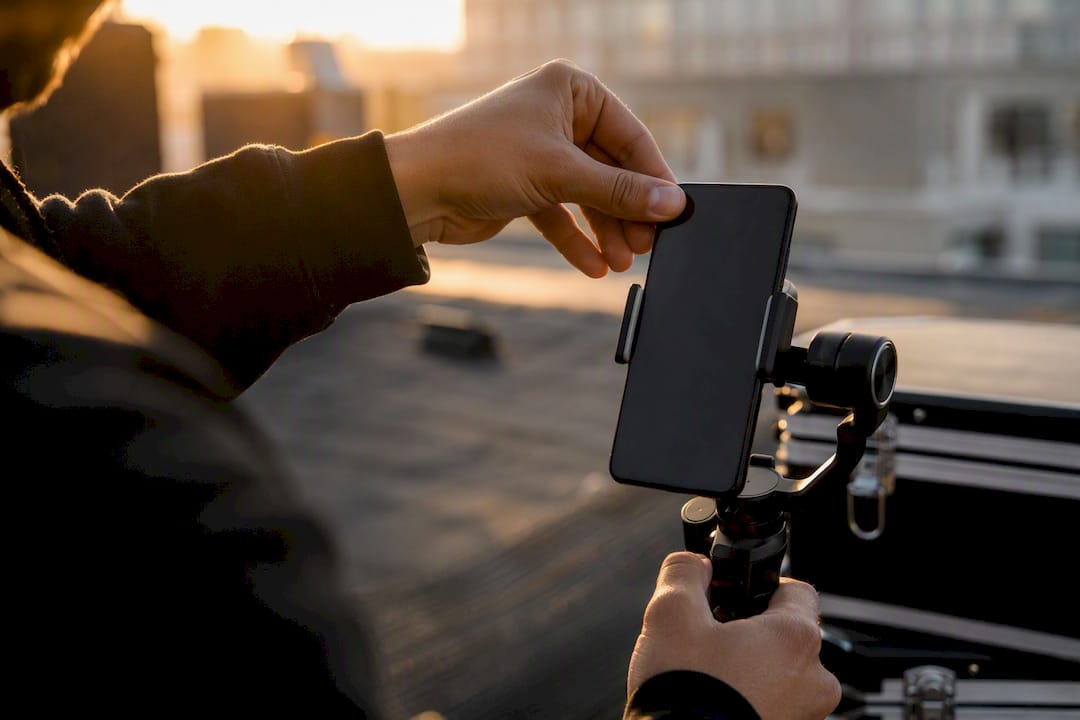
Test three to five creative variants per ad set and give each at least three to five days before judging results. A placement or format is working when its cost per result trends down as spend increases; it’s failing when frequency climbs past 3 to 4 without a matching lift in conversions.
What’s the fastest way to lower your Facebook ad costs?
Start with creative, not targeting. Most Australian advertisers who complain about high CPAs are running two or three ad variants when they need eight to ten, because Facebook’s system needs volume to find the winning combination and stale creative is the quickest way to watch your CPM climb week over week.
Fix your measurement next. Installing the Conversions API alongside your standard pixel, and cleaning up event hygiene so you’re not double counting or missing purchase events, typically improves optimisation more than any bidding change. Server-side tools such as TrackAff exist for exactly this problem, restoring signal that browser privacy settings strip out of standard pixel tracking.
Practical moves that consistently reduce cost:
Test five or more creative variants per ad set and kill underperformers within the first three to five days.
Use Advantage+ audience settings rather than narrow manual targeting unless your customer LTV clearly justifies the premium.
Set frequency caps or build exclusion lists for people who’ve already converted, so you’re not paying to re-show ads to existing customers.
Layer in Conversions API so Facebook’s algorithm sees the full picture of what happens after the click.
Review placement breakdowns weekly and shift budget away from placements with rising cost per result.
Pro Tip: Build a simple exclusion audience of everyone who’s purchased or submitted a lead form in the last 90 days, and apply it across every prospecting campaign. It’s the single easiest way to stop bidding against yourself for people who’ve already converted.
What do Facebook ad agencies in Australia typically charge?
Agency pricing in Australia splits roughly into four bands, and what you get for your money changes sharply between them. Junior freelancers or offshore managers typically charge AU$300 to AU$800 a month and handle basic campaign setup with limited strategic input. Entry-level local agencies sit around AU$800 to AU$2,000 a month, usually covering campaign management, basic reporting, and some creative direction.
Established mid-market agencies charge AU$2,000 to AU$5,000 a month, and this is where you typically get proper creative production, landing page optimisation, and Conversions API setup bundled in.
Match the fee model to your spend. If your monthly ad budget sits under AU$2,000, a flat fee usually makes more sense than a percentage arrangement. Signs it’s time to bring in a specialist rather than manage in-house:
Your ad spend is scaling past AU$3,000 to AU$5,000 a month and you can’t keep up with creative demands.
Your conversion setup involves multiple products, funnels, or lead qualification steps.
You’ve plateaued on CPA despite testing creative and can’t diagnose whether it’s a targeting, landing page, or measurement problem.
What happened when Sun State Digital rebuilt Ray White Aspley’s campaigns?
Sun State Digital worked with Ray White Aspley to cut lead costs significantly by rebuilding the creative approach, tightening audience targeting around genuine buyer and seller intent, and improving the landing page experience the ads pointed to… The pattern held across the campaign: better creative and a faster, more relevant landing page did more for cost per lead than any bid adjustment…
You can apply the same four steps this month without an agency:
Audit your last 90 days of ad creative and identify which single ad drove the lowest cost per result, then build three variations of it.
Check your landing page load speed and message match against your ad copy, since a mismatch here quietly inflates every metric downstream.
Confirm your Conversions API is firing correctly by checking event match quality in Meta Events Manager.
Set a frequency cap and exclusion list for existing customers before you spend another dollar on prospecting.
How does Facebook ads billing work for Australian advertisers?
Meta bills Australian advertisers in Australian dollars for most standard account setups, though currency defaults are tied to your Business Manager settings and can occasionally default to USD if the account was configured incorrectly at setup. Check your Ads Manager billing settings before your first campaign launches, because switching currency later can complicate your historical reporting.
Payment happens either through automatic charges, where Facebook bills your card or PayPal at a threshold amount or on a monthly cycle, or through manual payments, where you top up credit in advance. Most small Australian businesses use automatic billing with a credit card, since it’s the simplest to set up and reconcile.
Currency fluctuation matters more than most advertisers realise if you’re paying with a card denominated in a foreign currency or if your bank applies a conversion fee. Even small movements in the AUD/USD exchange rate can shift your effective CPM slightly if Meta’s backend pricing for your auction segment is influenced by advertiser competition from US-dollar markets. In practice, the effect is usually minor for locally targeted Australian campaigns, but it’s worth reconciling your invoiced amount against your bank statement monthly rather than assuming they match exactly.
GST applies to Meta’s advertising fees for Australian businesses, and Meta typically issues a tax invoice that itemises this separately, so factor that into your true monthly cost rather than budgeting off the raw ad spend figure alone.
What legal and compliance rules affect ad costs in Australia?
Compliance failures cost money in two ways: through ad rejections that waste learning phase momentum, and through the higher CPMs that come from a damaged ad account quality score. The Australian Privacy Principles under the Privacy Act govern how you collect and use customer data for retargeting audiences, and a poorly disclosed data collection practice on your landing page can create real legal exposure alongside any advertising penalty.
Certain categories face tighter restrictions that push costs up. Financial services, health claims, and anything resembling a credit or lending offer trigger Meta’s special ad category rules, which can restrict targeting options and, in turn, reduce audience size and lift CPM. Alcohol and gambling ads face additional restrictions under both Meta’s policies and Australian advertising standards, often requiring age gating that narrows the addressable audience further.
Ad content restrictions around misleading claims apply just as firmly on Facebook as they do under the Australian Consumer Law generally. An ad that overstates a result or omits a material condition risks rejection, and repeated rejections can flag your entire account for manual review, which slows delivery and often raises your effective cost per result while the account rebuilds trust with the platform.
Why Australian marketers need to rethink their 2026 ad budgets
The biggest mistake I see Australian advertisers make isn’t underspending, it’s under investing in creative while overinvesting in targeting precision. The auction has shifted decisively toward rewarding engaging content with cheaper delivery, which means a business willing to produce eight ad variants a month will consistently outperform a competitor spending twice as much on three tired ads. Start this week by auditing your worst performing ad, understanding exactly why it underperformed, and building your next batch of creative around what your best ad got right.
— Joshua
How Sun State Digital helps you cut Facebook ad costs, not just manage spend
Sun State Digital exists for Brisbane and Sunshine Coast business owners who want lower lead costs without hiring a full internal marketing team or gambling on a freelancer’s guesswork. Where a general agency might hand you a monthly report, Sun State Digital builds the creative, sets up the Conversions API tracking, and fixes the landing page all under one roof, so the fixes that actually move your CPA don’t get stuck between three different vendors pointing fingers at each other.
That integrated approach is exactly what worked for Ray White Aspley, and it’s built on the same principle running through this entire article: creative quality and clean measurement data beat clever bidding every time. If your Facebook ad costs feel out of control, or you’ve never actually modelled what a realistic budget looks like for your business, book a strategy session with our Google Ads and paid social team and we’ll walk through your numbers before you commit another dollar.
Sources
Recommended
Stay Inspired
Get fresh design insights, articles, and resources delivered straight to your inbox.
Latest Blogs



Stay Inspired
Get fresh design insights, articles, and resources delivered straight to your inbox.
Insights
Aug 28, 2026
Cut CPA With Creative and Tracking: Facebook Ad Costs Australia 2026
Cut CPA With Creative and Tracking: Facebook Ad Costs Australia 2026
2026 Australia benchmarks for Facebook ads: CPC AU$0.90–AU$2.50 and a rule to budget AU$1,000–AU$1,500/month. Learn the creative and tracking fixes that...
2026 Australia benchmarks for Facebook ads: CPC AU$0.90–AU$2.50 and a rule to budget AU$1,000–AU$1,500/month. Learn the creative and tracking fixes that...
Cut CPA With Creative and Tracking: Facebook Ad Costs Australia 2026
Expect to pay roughly AU$0.90 to AU$2.50 per click and AU$8 to AU$22 per thousand impressions on Facebook and Instagram in Australia this year, with the exact number swinging hard by industry and audience. The one rule that matters more than any benchmark: budget at least AU$1,000 to AU$1,500 a month, or the algorithm never gets enough data to learn who converts. Below, we discuss vertical differences and how to approach budget planning.
TL;DR:
An average Australian Facebook ad campaign costs between AU$0.90 and AU$2.50 per click, with higher costs in finance, real estate, and B2B sectors.
A monthly ad budget of at least AU$1,000 to AU$1,500 is essential for effective learning and optimization, especially for small businesses.
Creative quality, audience size, placement, and measurement accuracy are the main factors influencing ad costs and campaign performance.
Using automated bidding initially and switching to a cost cap can optimize results; a bid cap too early can hinder delivery.
Improving measurement tools and creative testing can cut costs significantly, with agencies like Sun State Digital focusing on these areas for better ROI.
Table of Contents
Facebook advertising cost Australia benchmarks by industry (2026)
How does Facebook’s ad auction actually set your price?
What actually drives your Facebook ad costs up or down?
How much should you budget for Facebook ads in Australia?
Which metrics should you track for each campaign goal?
How do placements and creative formats change your results?
What’s the fastest way to lower your Facebook ad costs?
What do Facebook ad agencies in Australia typically charge?
What happened when Sun State Digital rebuilt Ray White Aspley’s campaigns?
How does Facebook ads billing work for Australian advertisers?
What legal and compliance rules affect ad costs in Australia?
Why Australian marketers need to rethink their 2026 ad budgets
How Sun State Digital helps you cut Facebook ad costs, not just manage spend
Sources
Facebook advertising cost Australia benchmarks by industry (2026)
Blended figures across the Australian market sit at roughly AU$0.90 to AU$2.50 per click and AU$8 to AU$22 per thousand impressions, according to industry benchmarking for 2026. One dataset-style breakdown pegs the average closer to AU$0.94 CPC and AU$12.07 CPM when you blend placements and objectives together, which lands comfortably inside that wider range.
Those numbers are a starting point, not a promise. Facebook’s auction prices every advertiser against every other advertiser chasing the same eyeballs at the same moment, and some industries pay a premium for a reason we will get to in the next section.
Here is how the major Australian verticals typically stack up:
Ecommerce and retail: CPC around AU$0.80 to AU$1.80, CPM AU$10 to AU$18, CPA often AU$25 to AU$60 depending on average order value.
Food and beverage: CPC AU$0.60 to AU$1.50, CPM AU$8 to AU$15, with strong performance from local radius targeting around venues.
Fashion and beauty: CPC AU$0.70 to AU$1.60, CPM AU$9 to AU$17, heavily reliant on catalogue and video creative.
Home services and trades: CPL (cost per lead) AU$20 to AU$70, CPC AU$1.20 to AU$2.50, pricier because leads are high intent and competition is local and concentrated.
Real estate: CPC AU$1.00 to AU$2.20, CPM often AU$15 to AU$22, with cost per qualified enquiry ranging widely by suburb and property price point.
Finance and insurance: Among the most expensive categories, with CPC frequently above AU$2.00 and CPL sometimes exceeding AU$80, driven by regulatory scrutiny and high customer lifetime value.
B2B and professional services: CPC AU$1.50 to AU$3.00, CPL AU$40 to AU$150, reflecting smaller audiences and longer sales cycles.
ROAS (return on ad spend) varies just as much.
Seasonality affects costs, with CPMs generally rising in late-year retail periods and declining afterwards, so budgets should account for these typical fluctuations.
For a spreadsheet you can copy today, jot down these three figures for your vertical: your expected CPC, your expected CPM, and your target CPA. Everything else in your budget model flows from those three numbers.
How does Facebook’s ad auction actually set your price?
Facebook doesn’t sell impressions to the highest bidder. It runs an auction where your bid, your ad’s estimated action rate, and your ad’s quality score combine into a “total value” score, and the highest total value wins the placement, not the highest dollar figure. Meta’s own guidance on budgets and auction basics confirms this: a lower bid with stronger predicted engagement can beat a higher bid attached to a mediocre ad.
Predicted conversion value sits at the centre of this. Facebook estimates, in real time, how likely a specific person is to complete your chosen action, whether that’s a purchase, a lead form, or a video view. That’s why the same audience can cost wildly different amounts depending on what you’re optimising for. Optimising for purchases when you have a well-tuned pixel usually costs more per impression than optimising for traffic, because Facebook is chasing a rarer, more valuable action.
This explains why finance and real estate pay more than food and beverage. It isn’t punishment; it’s economics. Every finance brand in Australia is bidding for the same slice of high income, high intent audience, and the platform’s own scale amplifies that competition. With close to three billion monthly active users globally, demand for the best inventory never really lets up.
Your bidding strategy changes the effective cost too. Consider the trade-offs:
Automated bidding (highest volume): Lets Facebook chase the most results for your budget, usually the best starting point for new advertisers with limited data.
Cost cap: Sets a target average cost per result, useful once you know your break-even CPA and want to hold the line as you scale.
Bid cap: Sets a maximum for the auction bid itself, giving you tight control but risking underdelivery if you set it too conservatively.
ROAS goal: Available on purchase campaigns with enough conversion volume, and generally the strongest lever once you have 30 to 50 conversions a week feeding the algorithm.
For most Australian small businesses, starting broad on automated bidding and moving to a cost cap once you have a stable CPA is the more forgiving path. Locking in a bid cap too early, before Facebook has learned your audience, usually just starves your delivery.
What actually drives your Facebook ad costs up or down?
Four levers move your price more than anything else: audience size, creative quality, placement mix, and measurement accuracy. Get these right and your CPA can fall by half without touching your budget.
Audience size has an inverse relationship with CPM in most cases. Narrow an audience down to a tight interest stack of 50,000 people and you’ll often pay more per impression, because you’re asking the algorithm to find the same rare person again and again. Broader audiences, especially with Advantage+ audience expansion switched on, tend to find cheaper impressions because Facebook has more room to hunt for value.
Creative quality is the single biggest cost lever in 2026, arguably bigger than targeting. Facebook’s system rewards ads that people engage with by charging less to show them, which means a genuinely good hook, a strong first three seconds of video, or a thumbnail that stops the scroll can cut your CPM more than any audience tweak. Background from Australian benchmark analysis and agency playbooks consistently flags creative and measurement as the primary drivers of cost pressure heading into 2026, ahead of bidding tactics.
Placement matters because not all inventory is priced the same. Reels and Stories often carry lower CPMs than main feed simply because there’s more unsold inventory there, but conversion rates can differ too, so cheaper isn’t always cheaper per result.
Measurement quality decides whether Facebook can even learn properly. If your pixel is missing events, or you’re not sending server-side signals through the Conversions API, the algorithm is optimising on incomplete data, and your CPA drifts upward as a result. A tool like TrackAff exists specifically to fix this server-side gap for Australian advertisers who’ve lost tracking accuracy to browser privacy changes.
Narrow targeting is only justified when your customer lifetime value is high enough to absorb a premium CPM, think boutique real estate or high-ticket B2B, not general retail.
Pro Tip: Rotate your cold-audience creative every 10 to 14 days, or as soon as weekly frequency in that ad set climbs past 3.5. A frequency spike in a cold audience is almost always a creative fatigue problem, not a bidding problem, and refreshing the ad usually fixes the CPM faster than adjusting the bid ever will.
How much should you budget for Facebook ads in Australia?
Anything under roughly AU$1,000 a month rarely gives the algorithm enough conversions per week to optimise properly, a threshold echoed across Australian benchmark guides for 2026. Facebook’s own delivery system needs a steady stream of results, generally at least 15 to 25 conversions a week per ad set, before it exits the learning phase and starts finding your ideal customer efficiently. Spend too little and you’re stuck restarting that learning phase every time your budget shifts.
Realistic monthly bands by business type:
Local service businesses (tradies, clinics, salons): AU$800 to AU$1,500 a month, focused on lead generation within a tight geographic radius.
Established local services with multiple locations: AU$2,000 to AU$5,000 a month, often split across lead gen and retargeting.
Small ecommerce (under $500K annual revenue): AU$1,500 to AU$4,000 a month, weighted toward prospecting with a retargeting slice of 20 to 30%.
Scaled ecommerce brands: AU$5,000 to AU$20,000+ a month, usually running Advantage+ shopping alongside dedicated retargeting and loyalty campaigns.
B2B and SaaS: AU$2,000 to AU$8,000 a month, with a longer runway needed before CPA stabilises because sales cycles stretch the feedback loop.
The modelling method is simple once you break it into steps. Start with your audience size and expected CPM, calculate how many impressions that budget buys, apply your expected click-through rate to get clicks, then apply your website’s conversion rate to get leads or sales. Divide your budget by that number and you have your real CPL or CPA.
Say you budget AU$1,500 a month with a CPM of AU$15. That buys roughly 100,000 impressions. Run that math before you commit spend, and you’ll know within a day or two whether your target is realistic or needs adjusting.
Which metrics should you track for each campaign goal?
Match your primary metric to your campaign objective, not the other way around. Chasing a low CPC on a lead generation campaign is a common mistake, because a cheap click that never converts is worse than an expensive one that does.
Here’s what each metric measures and how to calculate it:
CPC (cost per click): Total spend divided by clicks. Track this for traffic and awareness campaigns where clicks themselves are the goal.
CPM (cost per thousand impressions): Total spend divided by impressions, multiplied by 1,000. Useful for brand awareness and reach campaigns.
CPL (cost per lead): Total spend divided by number of leads captured. This is the headline number for most local service businesses.
CPA (cost per acquisition): Total spend divided by number of completed sales or sign ups. The metric that matters most for ecommerce and subscription businesses.
CVR (conversion rate): Conversions divided by clicks, expressed as a percentage. This is the bridge between your click cost and your lead or sale cost.
ROAS (return on ad spend): Revenue generated divided by ad spend. For ecommerce, this is usually the final scorecard.
At an AU$1.20 CPC, that’s a AU$1,200 budget for that single campaign. Do this calculation before setting your monthly spend, not after.
How do placements and creative formats change your results?
Reels inventory in Australia generally carries a lower CPM than main feed placement, because Meta still has more unsold Reels inventory to fill, though that gap narrows every quarter as advertiser demand catches up. Stories sit somewhere between the two, and Audience Network, Facebook’s off-platform placement, tends to be cheapest but comes with the weakest average conversion quality for most Australian advertisers.
Short vertical video, ideally 6 to 15 seconds with the hook in the first two seconds, consistently outperforms static images on cost per result across every placement tested by Australian agencies. User-generated content style ads, the kind that look like a customer filmed them rather than a studio, tend to lower CPM because they blend into the feed rather than interrupt it. A strong thumbnail on video ads matters almost as much as the video itself, since Facebook shows a static frame before anyone taps play.
Test three to five creative variants per ad set and give each at least three to five days before judging results. A placement or format is working when its cost per result trends down as spend increases; it’s failing when frequency climbs past 3 to 4 without a matching lift in conversions.
What’s the fastest way to lower your Facebook ad costs?
Start with creative, not targeting. Most Australian advertisers who complain about high CPAs are running two or three ad variants when they need eight to ten, because Facebook’s system needs volume to find the winning combination and stale creative is the quickest way to watch your CPM climb week over week.
Fix your measurement next. Installing the Conversions API alongside your standard pixel, and cleaning up event hygiene so you’re not double counting or missing purchase events, typically improves optimisation more than any bidding change. Server-side tools such as TrackAff exist for exactly this problem, restoring signal that browser privacy settings strip out of standard pixel tracking.
Practical moves that consistently reduce cost:
Test five or more creative variants per ad set and kill underperformers within the first three to five days.
Use Advantage+ audience settings rather than narrow manual targeting unless your customer LTV clearly justifies the premium.
Set frequency caps or build exclusion lists for people who’ve already converted, so you’re not paying to re-show ads to existing customers.
Layer in Conversions API so Facebook’s algorithm sees the full picture of what happens after the click.
Review placement breakdowns weekly and shift budget away from placements with rising cost per result.
Pro Tip: Build a simple exclusion audience of everyone who’s purchased or submitted a lead form in the last 90 days, and apply it across every prospecting campaign. It’s the single easiest way to stop bidding against yourself for people who’ve already converted.
What do Facebook ad agencies in Australia typically charge?
Agency pricing in Australia splits roughly into four bands, and what you get for your money changes sharply between them. Junior freelancers or offshore managers typically charge AU$300 to AU$800 a month and handle basic campaign setup with limited strategic input. Entry-level local agencies sit around AU$800 to AU$2,000 a month, usually covering campaign management, basic reporting, and some creative direction.
Established mid-market agencies charge AU$2,000 to AU$5,000 a month, and this is where you typically get proper creative production, landing page optimisation, and Conversions API setup bundled in.
Match the fee model to your spend. If your monthly ad budget sits under AU$2,000, a flat fee usually makes more sense than a percentage arrangement. Signs it’s time to bring in a specialist rather than manage in-house:
Your ad spend is scaling past AU$3,000 to AU$5,000 a month and you can’t keep up with creative demands.
Your conversion setup involves multiple products, funnels, or lead qualification steps.
You’ve plateaued on CPA despite testing creative and can’t diagnose whether it’s a targeting, landing page, or measurement problem.
What happened when Sun State Digital rebuilt Ray White Aspley’s campaigns?
Sun State Digital worked with Ray White Aspley to cut lead costs significantly by rebuilding the creative approach, tightening audience targeting around genuine buyer and seller intent, and improving the landing page experience the ads pointed to… The pattern held across the campaign: better creative and a faster, more relevant landing page did more for cost per lead than any bid adjustment…
You can apply the same four steps this month without an agency:
Audit your last 90 days of ad creative and identify which single ad drove the lowest cost per result, then build three variations of it.
Check your landing page load speed and message match against your ad copy, since a mismatch here quietly inflates every metric downstream.
Confirm your Conversions API is firing correctly by checking event match quality in Meta Events Manager.
Set a frequency cap and exclusion list for existing customers before you spend another dollar on prospecting.
How does Facebook ads billing work for Australian advertisers?
Meta bills Australian advertisers in Australian dollars for most standard account setups, though currency defaults are tied to your Business Manager settings and can occasionally default to USD if the account was configured incorrectly at setup. Check your Ads Manager billing settings before your first campaign launches, because switching currency later can complicate your historical reporting.
Payment happens either through automatic charges, where Facebook bills your card or PayPal at a threshold amount or on a monthly cycle, or through manual payments, where you top up credit in advance. Most small Australian businesses use automatic billing with a credit card, since it’s the simplest to set up and reconcile.
Currency fluctuation matters more than most advertisers realise if you’re paying with a card denominated in a foreign currency or if your bank applies a conversion fee. Even small movements in the AUD/USD exchange rate can shift your effective CPM slightly if Meta’s backend pricing for your auction segment is influenced by advertiser competition from US-dollar markets. In practice, the effect is usually minor for locally targeted Australian campaigns, but it’s worth reconciling your invoiced amount against your bank statement monthly rather than assuming they match exactly.
GST applies to Meta’s advertising fees for Australian businesses, and Meta typically issues a tax invoice that itemises this separately, so factor that into your true monthly cost rather than budgeting off the raw ad spend figure alone.
What legal and compliance rules affect ad costs in Australia?
Compliance failures cost money in two ways: through ad rejections that waste learning phase momentum, and through the higher CPMs that come from a damaged ad account quality score. The Australian Privacy Principles under the Privacy Act govern how you collect and use customer data for retargeting audiences, and a poorly disclosed data collection practice on your landing page can create real legal exposure alongside any advertising penalty.
Certain categories face tighter restrictions that push costs up. Financial services, health claims, and anything resembling a credit or lending offer trigger Meta’s special ad category rules, which can restrict targeting options and, in turn, reduce audience size and lift CPM. Alcohol and gambling ads face additional restrictions under both Meta’s policies and Australian advertising standards, often requiring age gating that narrows the addressable audience further.
Ad content restrictions around misleading claims apply just as firmly on Facebook as they do under the Australian Consumer Law generally. An ad that overstates a result or omits a material condition risks rejection, and repeated rejections can flag your entire account for manual review, which slows delivery and often raises your effective cost per result while the account rebuilds trust with the platform.
Why Australian marketers need to rethink their 2026 ad budgets
The biggest mistake I see Australian advertisers make isn’t underspending, it’s under investing in creative while overinvesting in targeting precision. The auction has shifted decisively toward rewarding engaging content with cheaper delivery, which means a business willing to produce eight ad variants a month will consistently outperform a competitor spending twice as much on three tired ads. Start this week by auditing your worst performing ad, understanding exactly why it underperformed, and building your next batch of creative around what your best ad got right.
— Joshua
How Sun State Digital helps you cut Facebook ad costs, not just manage spend
Sun State Digital exists for Brisbane and Sunshine Coast business owners who want lower lead costs without hiring a full internal marketing team or gambling on a freelancer’s guesswork. Where a general agency might hand you a monthly report, Sun State Digital builds the creative, sets up the Conversions API tracking, and fixes the landing page all under one roof, so the fixes that actually move your CPA don’t get stuck between three different vendors pointing fingers at each other.
That integrated approach is exactly what worked for Ray White Aspley, and it’s built on the same principle running through this entire article: creative quality and clean measurement data beat clever bidding every time. If your Facebook ad costs feel out of control, or you’ve never actually modelled what a realistic budget looks like for your business, book a strategy session with our Google Ads and paid social team and we’ll walk through your numbers before you commit another dollar.
Sources
Recommended
Stay Inspired
Get fresh design insights, articles, and resources delivered straight to your inbox.
Latest Blogs
Stay Inspired
Get fresh design insights, articles, and resources delivered straight to your inbox.
Insights
Aug 28, 2026
Cut CPA With Creative and Tracking: Facebook Ad Costs Australia 2026
Cut CPA With Creative and Tracking: Facebook Ad Costs Australia 2026
2026 Australia benchmarks for Facebook ads: CPC AU$0.90–AU$2.50 and a rule to budget AU$1,000–AU$1,500/month. Learn the creative and tracking fixes that...
2026 Australia benchmarks for Facebook ads: CPC AU$0.90–AU$2.50 and a rule to budget AU$1,000–AU$1,500/month. Learn the creative and tracking fixes that...
Cut CPA With Creative and Tracking: Facebook Ad Costs Australia 2026
Expect to pay roughly AU$0.90 to AU$2.50 per click and AU$8 to AU$22 per thousand impressions on Facebook and Instagram in Australia this year, with the exact number swinging hard by industry and audience. The one rule that matters more than any benchmark: budget at least AU$1,000 to AU$1,500 a month, or the algorithm never gets enough data to learn who converts. Below, we discuss vertical differences and how to approach budget planning.
TL;DR:
An average Australian Facebook ad campaign costs between AU$0.90 and AU$2.50 per click, with higher costs in finance, real estate, and B2B sectors.
A monthly ad budget of at least AU$1,000 to AU$1,500 is essential for effective learning and optimization, especially for small businesses.
Creative quality, audience size, placement, and measurement accuracy are the main factors influencing ad costs and campaign performance.
Using automated bidding initially and switching to a cost cap can optimize results; a bid cap too early can hinder delivery.
Improving measurement tools and creative testing can cut costs significantly, with agencies like Sun State Digital focusing on these areas for better ROI.
Table of Contents
Facebook advertising cost Australia benchmarks by industry (2026)
How does Facebook’s ad auction actually set your price?
What actually drives your Facebook ad costs up or down?
How much should you budget for Facebook ads in Australia?
Which metrics should you track for each campaign goal?
How do placements and creative formats change your results?
What’s the fastest way to lower your Facebook ad costs?
What do Facebook ad agencies in Australia typically charge?
What happened when Sun State Digital rebuilt Ray White Aspley’s campaigns?
How does Facebook ads billing work for Australian advertisers?
What legal and compliance rules affect ad costs in Australia?
Why Australian marketers need to rethink their 2026 ad budgets
How Sun State Digital helps you cut Facebook ad costs, not just manage spend
Sources
Facebook advertising cost Australia benchmarks by industry (2026)
Blended figures across the Australian market sit at roughly AU$0.90 to AU$2.50 per click and AU$8 to AU$22 per thousand impressions, according to industry benchmarking for 2026. One dataset-style breakdown pegs the average closer to AU$0.94 CPC and AU$12.07 CPM when you blend placements and objectives together, which lands comfortably inside that wider range.
Those numbers are a starting point, not a promise. Facebook’s auction prices every advertiser against every other advertiser chasing the same eyeballs at the same moment, and some industries pay a premium for a reason we will get to in the next section.
Here is how the major Australian verticals typically stack up:
Ecommerce and retail: CPC around AU$0.80 to AU$1.80, CPM AU$10 to AU$18, CPA often AU$25 to AU$60 depending on average order value.
Food and beverage: CPC AU$0.60 to AU$1.50, CPM AU$8 to AU$15, with strong performance from local radius targeting around venues.
Fashion and beauty: CPC AU$0.70 to AU$1.60, CPM AU$9 to AU$17, heavily reliant on catalogue and video creative.
Home services and trades: CPL (cost per lead) AU$20 to AU$70, CPC AU$1.20 to AU$2.50, pricier because leads are high intent and competition is local and concentrated.
Real estate: CPC AU$1.00 to AU$2.20, CPM often AU$15 to AU$22, with cost per qualified enquiry ranging widely by suburb and property price point.
Finance and insurance: Among the most expensive categories, with CPC frequently above AU$2.00 and CPL sometimes exceeding AU$80, driven by regulatory scrutiny and high customer lifetime value.
B2B and professional services: CPC AU$1.50 to AU$3.00, CPL AU$40 to AU$150, reflecting smaller audiences and longer sales cycles.
ROAS (return on ad spend) varies just as much.
Seasonality affects costs, with CPMs generally rising in late-year retail periods and declining afterwards, so budgets should account for these typical fluctuations.
For a spreadsheet you can copy today, jot down these three figures for your vertical: your expected CPC, your expected CPM, and your target CPA. Everything else in your budget model flows from those three numbers.
How does Facebook’s ad auction actually set your price?
Facebook doesn’t sell impressions to the highest bidder. It runs an auction where your bid, your ad’s estimated action rate, and your ad’s quality score combine into a “total value” score, and the highest total value wins the placement, not the highest dollar figure. Meta’s own guidance on budgets and auction basics confirms this: a lower bid with stronger predicted engagement can beat a higher bid attached to a mediocre ad.
Predicted conversion value sits at the centre of this. Facebook estimates, in real time, how likely a specific person is to complete your chosen action, whether that’s a purchase, a lead form, or a video view. That’s why the same audience can cost wildly different amounts depending on what you’re optimising for. Optimising for purchases when you have a well-tuned pixel usually costs more per impression than optimising for traffic, because Facebook is chasing a rarer, more valuable action.
This explains why finance and real estate pay more than food and beverage. It isn’t punishment; it’s economics. Every finance brand in Australia is bidding for the same slice of high income, high intent audience, and the platform’s own scale amplifies that competition. With close to three billion monthly active users globally, demand for the best inventory never really lets up.
Your bidding strategy changes the effective cost too. Consider the trade-offs:
Automated bidding (highest volume): Lets Facebook chase the most results for your budget, usually the best starting point for new advertisers with limited data.
Cost cap: Sets a target average cost per result, useful once you know your break-even CPA and want to hold the line as you scale.
Bid cap: Sets a maximum for the auction bid itself, giving you tight control but risking underdelivery if you set it too conservatively.
ROAS goal: Available on purchase campaigns with enough conversion volume, and generally the strongest lever once you have 30 to 50 conversions a week feeding the algorithm.
For most Australian small businesses, starting broad on automated bidding and moving to a cost cap once you have a stable CPA is the more forgiving path. Locking in a bid cap too early, before Facebook has learned your audience, usually just starves your delivery.
What actually drives your Facebook ad costs up or down?
Four levers move your price more than anything else: audience size, creative quality, placement mix, and measurement accuracy. Get these right and your CPA can fall by half without touching your budget.
Audience size has an inverse relationship with CPM in most cases. Narrow an audience down to a tight interest stack of 50,000 people and you’ll often pay more per impression, because you’re asking the algorithm to find the same rare person again and again. Broader audiences, especially with Advantage+ audience expansion switched on, tend to find cheaper impressions because Facebook has more room to hunt for value.
Creative quality is the single biggest cost lever in 2026, arguably bigger than targeting. Facebook’s system rewards ads that people engage with by charging less to show them, which means a genuinely good hook, a strong first three seconds of video, or a thumbnail that stops the scroll can cut your CPM more than any audience tweak. Background from Australian benchmark analysis and agency playbooks consistently flags creative and measurement as the primary drivers of cost pressure heading into 2026, ahead of bidding tactics.
Placement matters because not all inventory is priced the same. Reels and Stories often carry lower CPMs than main feed simply because there’s more unsold inventory there, but conversion rates can differ too, so cheaper isn’t always cheaper per result.
Measurement quality decides whether Facebook can even learn properly. If your pixel is missing events, or you’re not sending server-side signals through the Conversions API, the algorithm is optimising on incomplete data, and your CPA drifts upward as a result. A tool like TrackAff exists specifically to fix this server-side gap for Australian advertisers who’ve lost tracking accuracy to browser privacy changes.
Narrow targeting is only justified when your customer lifetime value is high enough to absorb a premium CPM, think boutique real estate or high-ticket B2B, not general retail.
Pro Tip: Rotate your cold-audience creative every 10 to 14 days, or as soon as weekly frequency in that ad set climbs past 3.5. A frequency spike in a cold audience is almost always a creative fatigue problem, not a bidding problem, and refreshing the ad usually fixes the CPM faster than adjusting the bid ever will.
How much should you budget for Facebook ads in Australia?
Anything under roughly AU$1,000 a month rarely gives the algorithm enough conversions per week to optimise properly, a threshold echoed across Australian benchmark guides for 2026. Facebook’s own delivery system needs a steady stream of results, generally at least 15 to 25 conversions a week per ad set, before it exits the learning phase and starts finding your ideal customer efficiently. Spend too little and you’re stuck restarting that learning phase every time your budget shifts.
Realistic monthly bands by business type:
Local service businesses (tradies, clinics, salons): AU$800 to AU$1,500 a month, focused on lead generation within a tight geographic radius.
Established local services with multiple locations: AU$2,000 to AU$5,000 a month, often split across lead gen and retargeting.
Small ecommerce (under $500K annual revenue): AU$1,500 to AU$4,000 a month, weighted toward prospecting with a retargeting slice of 20 to 30%.
Scaled ecommerce brands: AU$5,000 to AU$20,000+ a month, usually running Advantage+ shopping alongside dedicated retargeting and loyalty campaigns.
B2B and SaaS: AU$2,000 to AU$8,000 a month, with a longer runway needed before CPA stabilises because sales cycles stretch the feedback loop.
The modelling method is simple once you break it into steps. Start with your audience size and expected CPM, calculate how many impressions that budget buys, apply your expected click-through rate to get clicks, then apply your website’s conversion rate to get leads or sales. Divide your budget by that number and you have your real CPL or CPA.
Say you budget AU$1,500 a month with a CPM of AU$15. That buys roughly 100,000 impressions. Run that math before you commit spend, and you’ll know within a day or two whether your target is realistic or needs adjusting.
Which metrics should you track for each campaign goal?
Match your primary metric to your campaign objective, not the other way around. Chasing a low CPC on a lead generation campaign is a common mistake, because a cheap click that never converts is worse than an expensive one that does.
Here’s what each metric measures and how to calculate it:
CPC (cost per click): Total spend divided by clicks. Track this for traffic and awareness campaigns where clicks themselves are the goal.
CPM (cost per thousand impressions): Total spend divided by impressions, multiplied by 1,000. Useful for brand awareness and reach campaigns.
CPL (cost per lead): Total spend divided by number of leads captured. This is the headline number for most local service businesses.
CPA (cost per acquisition): Total spend divided by number of completed sales or sign ups. The metric that matters most for ecommerce and subscription businesses.
CVR (conversion rate): Conversions divided by clicks, expressed as a percentage. This is the bridge between your click cost and your lead or sale cost.
ROAS (return on ad spend): Revenue generated divided by ad spend. For ecommerce, this is usually the final scorecard.
At an AU$1.20 CPC, that’s a AU$1,200 budget for that single campaign. Do this calculation before setting your monthly spend, not after.
How do placements and creative formats change your results?
Reels inventory in Australia generally carries a lower CPM than main feed placement, because Meta still has more unsold Reels inventory to fill, though that gap narrows every quarter as advertiser demand catches up. Stories sit somewhere between the two, and Audience Network, Facebook’s off-platform placement, tends to be cheapest but comes with the weakest average conversion quality for most Australian advertisers.
Short vertical video, ideally 6 to 15 seconds with the hook in the first two seconds, consistently outperforms static images on cost per result across every placement tested by Australian agencies. User-generated content style ads, the kind that look like a customer filmed them rather than a studio, tend to lower CPM because they blend into the feed rather than interrupt it. A strong thumbnail on video ads matters almost as much as the video itself, since Facebook shows a static frame before anyone taps play.
Test three to five creative variants per ad set and give each at least three to five days before judging results. A placement or format is working when its cost per result trends down as spend increases; it’s failing when frequency climbs past 3 to 4 without a matching lift in conversions.
What’s the fastest way to lower your Facebook ad costs?
Start with creative, not targeting. Most Australian advertisers who complain about high CPAs are running two or three ad variants when they need eight to ten, because Facebook’s system needs volume to find the winning combination and stale creative is the quickest way to watch your CPM climb week over week.
Fix your measurement next. Installing the Conversions API alongside your standard pixel, and cleaning up event hygiene so you’re not double counting or missing purchase events, typically improves optimisation more than any bidding change. Server-side tools such as TrackAff exist for exactly this problem, restoring signal that browser privacy settings strip out of standard pixel tracking.
Practical moves that consistently reduce cost:
Test five or more creative variants per ad set and kill underperformers within the first three to five days.
Use Advantage+ audience settings rather than narrow manual targeting unless your customer LTV clearly justifies the premium.
Set frequency caps or build exclusion lists for people who’ve already converted, so you’re not paying to re-show ads to existing customers.
Layer in Conversions API so Facebook’s algorithm sees the full picture of what happens after the click.
Review placement breakdowns weekly and shift budget away from placements with rising cost per result.
Pro Tip: Build a simple exclusion audience of everyone who’s purchased or submitted a lead form in the last 90 days, and apply it across every prospecting campaign. It’s the single easiest way to stop bidding against yourself for people who’ve already converted.
What do Facebook ad agencies in Australia typically charge?
Agency pricing in Australia splits roughly into four bands, and what you get for your money changes sharply between them. Junior freelancers or offshore managers typically charge AU$300 to AU$800 a month and handle basic campaign setup with limited strategic input. Entry-level local agencies sit around AU$800 to AU$2,000 a month, usually covering campaign management, basic reporting, and some creative direction.
Established mid-market agencies charge AU$2,000 to AU$5,000 a month, and this is where you typically get proper creative production, landing page optimisation, and Conversions API setup bundled in.
Match the fee model to your spend. If your monthly ad budget sits under AU$2,000, a flat fee usually makes more sense than a percentage arrangement. Signs it’s time to bring in a specialist rather than manage in-house:
Your ad spend is scaling past AU$3,000 to AU$5,000 a month and you can’t keep up with creative demands.
Your conversion setup involves multiple products, funnels, or lead qualification steps.
You’ve plateaued on CPA despite testing creative and can’t diagnose whether it’s a targeting, landing page, or measurement problem.
What happened when Sun State Digital rebuilt Ray White Aspley’s campaigns?
Sun State Digital worked with Ray White Aspley to cut lead costs significantly by rebuilding the creative approach, tightening audience targeting around genuine buyer and seller intent, and improving the landing page experience the ads pointed to… The pattern held across the campaign: better creative and a faster, more relevant landing page did more for cost per lead than any bid adjustment…
You can apply the same four steps this month without an agency:
Audit your last 90 days of ad creative and identify which single ad drove the lowest cost per result, then build three variations of it.
Check your landing page load speed and message match against your ad copy, since a mismatch here quietly inflates every metric downstream.
Confirm your Conversions API is firing correctly by checking event match quality in Meta Events Manager.
Set a frequency cap and exclusion list for existing customers before you spend another dollar on prospecting.
How does Facebook ads billing work for Australian advertisers?
Meta bills Australian advertisers in Australian dollars for most standard account setups, though currency defaults are tied to your Business Manager settings and can occasionally default to USD if the account was configured incorrectly at setup. Check your Ads Manager billing settings before your first campaign launches, because switching currency later can complicate your historical reporting.
Payment happens either through automatic charges, where Facebook bills your card or PayPal at a threshold amount or on a monthly cycle, or through manual payments, where you top up credit in advance. Most small Australian businesses use automatic billing with a credit card, since it’s the simplest to set up and reconcile.
Currency fluctuation matters more than most advertisers realise if you’re paying with a card denominated in a foreign currency or if your bank applies a conversion fee. Even small movements in the AUD/USD exchange rate can shift your effective CPM slightly if Meta’s backend pricing for your auction segment is influenced by advertiser competition from US-dollar markets. In practice, the effect is usually minor for locally targeted Australian campaigns, but it’s worth reconciling your invoiced amount against your bank statement monthly rather than assuming they match exactly.
GST applies to Meta’s advertising fees for Australian businesses, and Meta typically issues a tax invoice that itemises this separately, so factor that into your true monthly cost rather than budgeting off the raw ad spend figure alone.
What legal and compliance rules affect ad costs in Australia?
Compliance failures cost money in two ways: through ad rejections that waste learning phase momentum, and through the higher CPMs that come from a damaged ad account quality score. The Australian Privacy Principles under the Privacy Act govern how you collect and use customer data for retargeting audiences, and a poorly disclosed data collection practice on your landing page can create real legal exposure alongside any advertising penalty.
Certain categories face tighter restrictions that push costs up. Financial services, health claims, and anything resembling a credit or lending offer trigger Meta’s special ad category rules, which can restrict targeting options and, in turn, reduce audience size and lift CPM. Alcohol and gambling ads face additional restrictions under both Meta’s policies and Australian advertising standards, often requiring age gating that narrows the addressable audience further.
Ad content restrictions around misleading claims apply just as firmly on Facebook as they do under the Australian Consumer Law generally. An ad that overstates a result or omits a material condition risks rejection, and repeated rejections can flag your entire account for manual review, which slows delivery and often raises your effective cost per result while the account rebuilds trust with the platform.
Why Australian marketers need to rethink their 2026 ad budgets
The biggest mistake I see Australian advertisers make isn’t underspending, it’s under investing in creative while overinvesting in targeting precision. The auction has shifted decisively toward rewarding engaging content with cheaper delivery, which means a business willing to produce eight ad variants a month will consistently outperform a competitor spending twice as much on three tired ads. Start this week by auditing your worst performing ad, understanding exactly why it underperformed, and building your next batch of creative around what your best ad got right.
— Joshua
How Sun State Digital helps you cut Facebook ad costs, not just manage spend
Sun State Digital exists for Brisbane and Sunshine Coast business owners who want lower lead costs without hiring a full internal marketing team or gambling on a freelancer’s guesswork. Where a general agency might hand you a monthly report, Sun State Digital builds the creative, sets up the Conversions API tracking, and fixes the landing page all under one roof, so the fixes that actually move your CPA don’t get stuck between three different vendors pointing fingers at each other.
That integrated approach is exactly what worked for Ray White Aspley, and it’s built on the same principle running through this entire article: creative quality and clean measurement data beat clever bidding every time. If your Facebook ad costs feel out of control, or you’ve never actually modelled what a realistic budget looks like for your business, book a strategy session with our Google Ads and paid social team and we’ll walk through your numbers before you commit another dollar.
Sources
Recommended
Stay Inspired
Get fresh design insights, articles, and resources delivered straight to your inbox.
Latest Blogs
Stay Inspired
Get fresh design insights, articles, and resources delivered straight to your inbox.