
Insights
Aug 18, 2026
Real estate lead generation: what to fix first
Real estate lead generation: what to fix first
Boost your real estate lead generation by fixing existing systems first. Learn proven strategies to increase conversions and optimize results.
Boost your real estate lead generation by fixing existing systems first. Learn proven strategies to increase conversions and optimize results.
Real estate lead generation: what to fix first
The fastest gains in real estate lead generation come from activating your existing database, cutting response times, automating follow-up in your CRM, and running a tested paid funnel, in that order. Most agencies chase new traffic before fixing the leaks in what they already have. Get these four right and the rest is optimisation, not guesswork.
First: Reconnect with past clients, appraisals and expired listings this week.
Second: Get speed-to-lead under five minutes with automated alerts.
Third: Set up CRM workflows so no lead goes cold from human forgetfulness.
Fourth: Test a small paid budget once your follow-up system can handle the volume.
Sun State Digital helped Ray White Aspley cut lead costs significantly using this exact sequence.
Key Takeaways
Real estate lead generation improves fastest when agents activate their existing database, cut response times to minutes, and automate follow-up before scaling paid spend.
Point | Details |
|---|---|
Database first | Recontact past sellers, appraisal leads and expired listings before spending on new traffic. |
Speed decides conversion | Aim for automated SMS and call alerts within five minutes of a new enquiry. |
Match ad type to goal | Use lead ads for volume, landing pages for higher-intent, qualified enquiries. |
Track the full funnel | Measure cost per lead through to cost per close, not just form fills. |
Sun State Digital delivers results | Rebuilt Ray White Aspley’s funnel with CRM automation and landing pages, cutting lead costs. |
Table of Contents
Ranked tactical strategies for real estate lead generation
How do you activate your existing database?
Why does response speed decide whether a lead converts?
Should you use lead ads or landing pages?
Which organic channels actually generate real estate leads?
What KPIs actually tell you if a channel is working?
What does a 60 to 90 day plan look like?
How Sun State Digital cut lead costs for Ray White Aspley
What we see working for agencies now
Get your funnel fixed before you spend more on ads
Sources
Ranked tactical strategies for real estate lead generation
Not every tactic deserves equal attention, especially if you’re running a small team. Here’s the order that tends to produce results fastest, based on what consistently works across agent playbooks and paid funnel data.
Database activation. Your past clients, appraisal leads and open-house sign-ins are warmer than any cold audience you’ll pay to reach. Start here, this week, with zero ad spend.
Speed-to-lead and CRM automation. A lead that waits an hour for a callback is often already lost. Build the automation before you build the traffic.
Paid conversion points. Once follow-up is solid, choose between in-platform lead ads (fast, cheap, lower intent) and landing pages (slower to fill, higher quality).
Content and social. Video walkthroughs and neighbourhood guides build a pipeline that compounds over months rather than days.
Referrals and local partnerships. Slow to build, but among the most reliable sources of leads once established, particularly combined with digital follow-up.
Measurement and iteration. Track cost per lead, appointment rate and cost per close, then feed that data back into whichever channel is working.
Quick wins sit at the top of that list. Database activation and speed-to-lead cost almost nothing beyond a properly configured CRM and some disciplined time. The longer plays, content and referral networks, need months to mature but keep producing without a media budget once they’re running. A sensible approach runs both tracks simultaneously rather than waiting for one to finish before starting the next.
How do you activate your existing database?
Your CRM is probably sitting on more opportunity than any ad campaign you could launch tomorrow. Start with the segments most likely to move fast:
Sellers who had an appraisal in the last 12 months but didn’t list
Past clients approaching their settlement anniversary
Open-house attendees who never received a follow-up
Expired or withdrawn listings
Buyers who missed out on a property and went quiet
Work through them in a set sequence rather than a scattergun blast:
SMS first, short and personal, referencing the specific property or date.
Follow with a phone call within 24 hours if there’s no response.
Send a value-add email (a market update or fresh appraisal offer) to anyone who hasn’t engaged.
Retarget non-responders with a low-cost social ad after two weeks.
Score prospects by recency and intent signal. Someone who opened three emails and clicked a listing link is a different priority to someone who’s ignored six months of newsletters.
Pro Tip: Sort your database by settlement date and appraisal date before anything else. Anniversaries and stale appraisals produce disproportionately high answer rates because the reason to call is genuinely relevant to them.
Why does response speed decide whether a lead converts?
Contact rates fall sharply once you get past the first few minutes after someone enquires, and integrated CRM automation that fires an immediate SMS and routes the lead to a dialler is now common practice among high-performing teams. Treat five minutes as the target, not fifteen.
Build the automation once and it runs indefinitely:
New lead hits your CRM via webhook
Instant SMS confirms receipt and sets expectations
Alert pings the assigned agent’s phone
If no action in ten minutes, it escalates to a second team member
Triage with one to three questions before anyone picks up the phone: timeline to buy or sell, whether they’re already working with an agent, and rough budget or property type. That alone tells your team who to call first.
Pro Tip: Log speed-to-lead as a KPI in your weekly team meeting, not just a CRM setting nobody checks.
Should you use lead ads or landing pages?
Meta’s in-platform lead forms fill your pipeline cheaply, but they produce lower-intent enquiries unless the form uses qualifying questions and the Higher Intent setting, paired with fast follow-up. Landing pages cost more per lead but tend to arrive warmer, since the prospect has already clicked through and read your offer.
Landing pages that convert share a pattern:
One offer per page (a free appraisal, not five separate services)
Social proof near the form, not buried below the fold
Three or four form fields maximum
A single, unmissable call to action
Fast mobile load, since most property searches happen on a phone
Match your offer to the campaign goal. A free market appraisal suits sellers, a buyers list signup suits early-stage purchasers, and an open-house RSVP works for warm, ready-to-move buyers. Sun State Digital builds these pages as part of its website design and development work, and the same principles apply whether you’re capturing form fills through Meta or Google Ads.
Pro Tip: Add one qualifying question to every lead form. Cost per lead rises slightly, but appointment rates usually rise more.
Which organic channels actually generate real estate leads?
Video walkthroughs, neighbourhood guides and free valuation reports consistently outperform generic listing posts because they answer a specific question a buyer or seller is already asking. Long-form blog content earns its keep slowly through search, but it keeps working long after a paid campaign ends.
Short video walkthroughs for active listings
Suburb guides covering schools, transport and price trends
Automated valuation offers to capture seller intent
Separate nurture sequences for buyers (listing alerts) and sellers (market updates)
Local business partnerships, such as referral arrangements with mortgage brokers, conveyancers or removalists
A multi-channel mix across social, email and local partnerships gives agents the best chance of capturing different buyer and seller intents rather than relying on a single source that can dry up overnight.
Pro Tip: Repurpose one listing walkthrough into three assets: a reel, a suburb guide mention and an email feature. One shoot, three touchpoints.
What KPIs actually tell you if a channel is working?
Track cost per lead, contact rate, appointment rate, cost per appointment, cost per close and time-to-close. Cost per lead alone tells you almost nothing if half those leads never answer the phone.
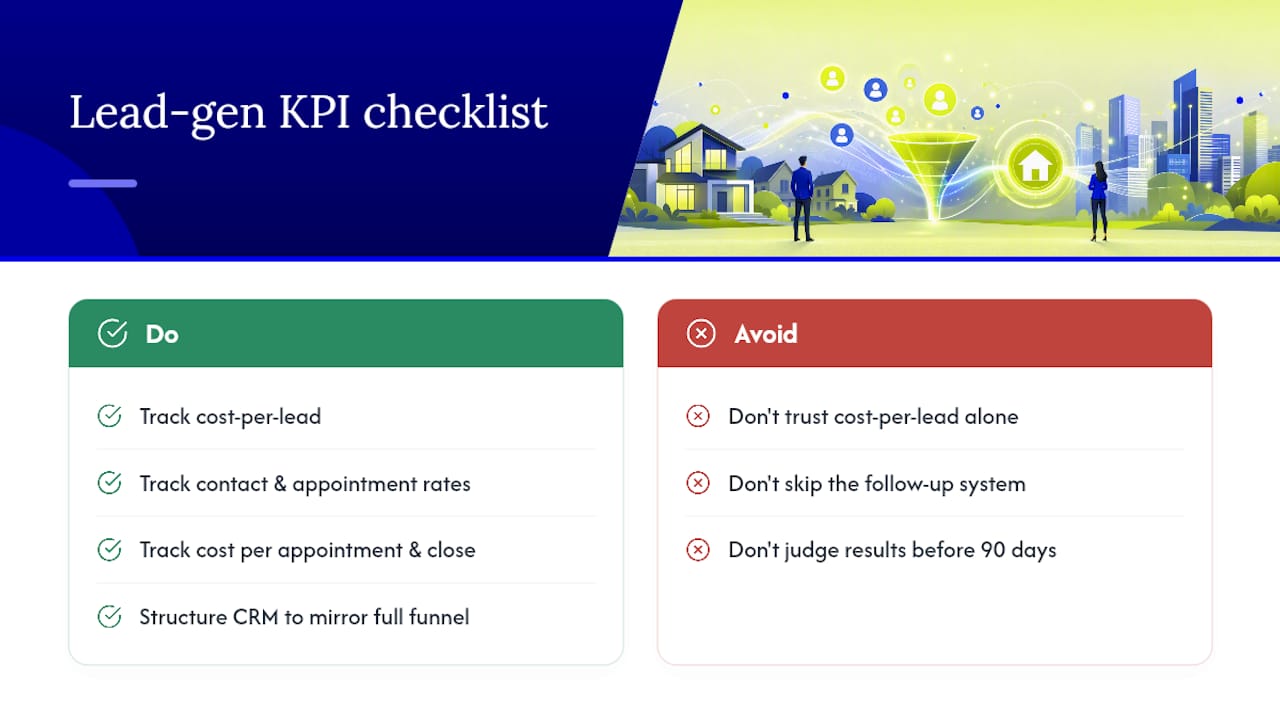
Budget-wise, many agents start with a modest monthly test spend, prioritising the follow-up system over raw ad dollars. Expect 30 days to validate creative and offer, 60 days to see a repeatable contact and appointment rate, and 90 days before cost per close settles into a reliable number.
Structure your CRM stages to mirror the full funnel: new lead, contacted, qualified, appointment, agreement, closed. Feed closed outcomes back into your ad platform so it learns which leads actually convert, not just which ones fill a form.
What does a 60 to 90 day plan look like?
Small teams need a sequence, not a wishlist. This order works for most solo agents and small offices:
Weeks 1 to 2: Segment and contact your database. No ad spend yet.
Weeks 3 to 4: Set up CRM automation for speed-to-lead and triage.
Weeks 5 to 6: Launch one paid campaign, either lead ads or a landing page, not both at once.
Weeks 7 to 8: Review contact and appointment rates, cut what isn’t converting.
Days 60 to 90: Scale the channel that’s producing appointments at an acceptable cost, add content to support it.
Decision rules keep this honest:
Pause a channel if contact rate stays below 20% after two weeks of proper follow-up.
Double down when cost per appointment is falling week on week.
Hire a virtual assistant for lead triage once volume exceeds what one agent can call within the five-minute window.
How Sun State Digital cut lead costs for Ray White Aspley
Ray White Aspley needed lower lead costs and more listing consultations without expanding their marketing budget. Sun State Digital rebuilt their conversion funnel: a dedicated landing page, CRM automation for instant follow-up, and a tightened paid campaign structure feeding qualified leads back into the platform for optimisation.
The result was a meaningful drop in cost per lead alongside a rise in booked appointments, proof that fixing the funnel before increasing spend is usually the higher-leverage move.
Full details sit in the Ray White Aspley case study.
What we see working for agencies now
The agents getting the best results aren’t the ones spending the most on ads. They’re the ones who fixed speed-to-lead and database follow-up before touching a paid budget. I still see teams pour thousands into Meta campaigns while a warm appraisal lead from eight months ago sits untouched in their CRM.

My one habit worth stealing: block 30 minutes every Monday purely for database recontact, before checking any ad dashboard.
Get your funnel fixed before you spend more on ads
Sun State Digital is the alternative to guessing which channel will work. We build the CRM automation, landing pages and paid funnels first, then only recommend spending once the follow-up system can actually convert what comes in.

If you’re not sure where your funnel is leaking leads, a few starting points:
A strategy session to map your current database and identify quick wins
A conversion audit of your existing landing pages and ad forms
Full CRM onboarding and automation setup for speed-to-lead
The Ray White Aspley result came from exactly this process. If you want the same starting point, book a strategy session through the Sun State Digital website and we’ll map out where your leads are currently going cold.
Sources
Facebook lead ads for real estate: the 2026 agent’s playbook
8 invaluable lead generation ideas for agents and brokers | NAR
Recommended
Stay Inspired
Get fresh design insights, articles, and resources delivered straight to your inbox.
Latest Blogs



Stay Inspired
Get fresh design insights, articles, and resources delivered straight to your inbox.
Insights
Aug 18, 2026
Real estate lead generation: what to fix first
Real estate lead generation: what to fix first
Boost your real estate lead generation by fixing existing systems first. Learn proven strategies to increase conversions and optimize results.
Boost your real estate lead generation by fixing existing systems first. Learn proven strategies to increase conversions and optimize results.
Real estate lead generation: what to fix first
The fastest gains in real estate lead generation come from activating your existing database, cutting response times, automating follow-up in your CRM, and running a tested paid funnel, in that order. Most agencies chase new traffic before fixing the leaks in what they already have. Get these four right and the rest is optimisation, not guesswork.
First: Reconnect with past clients, appraisals and expired listings this week.
Second: Get speed-to-lead under five minutes with automated alerts.
Third: Set up CRM workflows so no lead goes cold from human forgetfulness.
Fourth: Test a small paid budget once your follow-up system can handle the volume.
Sun State Digital helped Ray White Aspley cut lead costs significantly using this exact sequence.
Key Takeaways
Real estate lead generation improves fastest when agents activate their existing database, cut response times to minutes, and automate follow-up before scaling paid spend.
Point | Details |
|---|---|
Database first | Recontact past sellers, appraisal leads and expired listings before spending on new traffic. |
Speed decides conversion | Aim for automated SMS and call alerts within five minutes of a new enquiry. |
Match ad type to goal | Use lead ads for volume, landing pages for higher-intent, qualified enquiries. |
Track the full funnel | Measure cost per lead through to cost per close, not just form fills. |
Sun State Digital delivers results | Rebuilt Ray White Aspley’s funnel with CRM automation and landing pages, cutting lead costs. |
Table of Contents
Ranked tactical strategies for real estate lead generation
How do you activate your existing database?
Why does response speed decide whether a lead converts?
Should you use lead ads or landing pages?
Which organic channels actually generate real estate leads?
What KPIs actually tell you if a channel is working?
What does a 60 to 90 day plan look like?
How Sun State Digital cut lead costs for Ray White Aspley
What we see working for agencies now
Get your funnel fixed before you spend more on ads
Sources
Ranked tactical strategies for real estate lead generation
Not every tactic deserves equal attention, especially if you’re running a small team. Here’s the order that tends to produce results fastest, based on what consistently works across agent playbooks and paid funnel data.
Database activation. Your past clients, appraisal leads and open-house sign-ins are warmer than any cold audience you’ll pay to reach. Start here, this week, with zero ad spend.
Speed-to-lead and CRM automation. A lead that waits an hour for a callback is often already lost. Build the automation before you build the traffic.
Paid conversion points. Once follow-up is solid, choose between in-platform lead ads (fast, cheap, lower intent) and landing pages (slower to fill, higher quality).
Content and social. Video walkthroughs and neighbourhood guides build a pipeline that compounds over months rather than days.
Referrals and local partnerships. Slow to build, but among the most reliable sources of leads once established, particularly combined with digital follow-up.
Measurement and iteration. Track cost per lead, appointment rate and cost per close, then feed that data back into whichever channel is working.
Quick wins sit at the top of that list. Database activation and speed-to-lead cost almost nothing beyond a properly configured CRM and some disciplined time. The longer plays, content and referral networks, need months to mature but keep producing without a media budget once they’re running. A sensible approach runs both tracks simultaneously rather than waiting for one to finish before starting the next.
How do you activate your existing database?
Your CRM is probably sitting on more opportunity than any ad campaign you could launch tomorrow. Start with the segments most likely to move fast:
Sellers who had an appraisal in the last 12 months but didn’t list
Past clients approaching their settlement anniversary
Open-house attendees who never received a follow-up
Expired or withdrawn listings
Buyers who missed out on a property and went quiet
Work through them in a set sequence rather than a scattergun blast:
SMS first, short and personal, referencing the specific property or date.
Follow with a phone call within 24 hours if there’s no response.
Send a value-add email (a market update or fresh appraisal offer) to anyone who hasn’t engaged.
Retarget non-responders with a low-cost social ad after two weeks.
Score prospects by recency and intent signal. Someone who opened three emails and clicked a listing link is a different priority to someone who’s ignored six months of newsletters.
Pro Tip: Sort your database by settlement date and appraisal date before anything else. Anniversaries and stale appraisals produce disproportionately high answer rates because the reason to call is genuinely relevant to them.
Why does response speed decide whether a lead converts?
Contact rates fall sharply once you get past the first few minutes after someone enquires, and integrated CRM automation that fires an immediate SMS and routes the lead to a dialler is now common practice among high-performing teams. Treat five minutes as the target, not fifteen.
Build the automation once and it runs indefinitely:
New lead hits your CRM via webhook
Instant SMS confirms receipt and sets expectations
Alert pings the assigned agent’s phone
If no action in ten minutes, it escalates to a second team member
Triage with one to three questions before anyone picks up the phone: timeline to buy or sell, whether they’re already working with an agent, and rough budget or property type. That alone tells your team who to call first.
Pro Tip: Log speed-to-lead as a KPI in your weekly team meeting, not just a CRM setting nobody checks.
Should you use lead ads or landing pages?
Meta’s in-platform lead forms fill your pipeline cheaply, but they produce lower-intent enquiries unless the form uses qualifying questions and the Higher Intent setting, paired with fast follow-up. Landing pages cost more per lead but tend to arrive warmer, since the prospect has already clicked through and read your offer.
Landing pages that convert share a pattern:
One offer per page (a free appraisal, not five separate services)
Social proof near the form, not buried below the fold
Three or four form fields maximum
A single, unmissable call to action
Fast mobile load, since most property searches happen on a phone
Match your offer to the campaign goal. A free market appraisal suits sellers, a buyers list signup suits early-stage purchasers, and an open-house RSVP works for warm, ready-to-move buyers. Sun State Digital builds these pages as part of its website design and development work, and the same principles apply whether you’re capturing form fills through Meta or Google Ads.
Pro Tip: Add one qualifying question to every lead form. Cost per lead rises slightly, but appointment rates usually rise more.
Which organic channels actually generate real estate leads?
Video walkthroughs, neighbourhood guides and free valuation reports consistently outperform generic listing posts because they answer a specific question a buyer or seller is already asking. Long-form blog content earns its keep slowly through search, but it keeps working long after a paid campaign ends.
Short video walkthroughs for active listings
Suburb guides covering schools, transport and price trends
Automated valuation offers to capture seller intent
Separate nurture sequences for buyers (listing alerts) and sellers (market updates)
Local business partnerships, such as referral arrangements with mortgage brokers, conveyancers or removalists
A multi-channel mix across social, email and local partnerships gives agents the best chance of capturing different buyer and seller intents rather than relying on a single source that can dry up overnight.
Pro Tip: Repurpose one listing walkthrough into three assets: a reel, a suburb guide mention and an email feature. One shoot, three touchpoints.
What KPIs actually tell you if a channel is working?
Track cost per lead, contact rate, appointment rate, cost per appointment, cost per close and time-to-close. Cost per lead alone tells you almost nothing if half those leads never answer the phone.
Budget-wise, many agents start with a modest monthly test spend, prioritising the follow-up system over raw ad dollars. Expect 30 days to validate creative and offer, 60 days to see a repeatable contact and appointment rate, and 90 days before cost per close settles into a reliable number.
Structure your CRM stages to mirror the full funnel: new lead, contacted, qualified, appointment, agreement, closed. Feed closed outcomes back into your ad platform so it learns which leads actually convert, not just which ones fill a form.
What does a 60 to 90 day plan look like?
Small teams need a sequence, not a wishlist. This order works for most solo agents and small offices:
Weeks 1 to 2: Segment and contact your database. No ad spend yet.
Weeks 3 to 4: Set up CRM automation for speed-to-lead and triage.
Weeks 5 to 6: Launch one paid campaign, either lead ads or a landing page, not both at once.
Weeks 7 to 8: Review contact and appointment rates, cut what isn’t converting.
Days 60 to 90: Scale the channel that’s producing appointments at an acceptable cost, add content to support it.
Decision rules keep this honest:
Pause a channel if contact rate stays below 20% after two weeks of proper follow-up.
Double down when cost per appointment is falling week on week.
Hire a virtual assistant for lead triage once volume exceeds what one agent can call within the five-minute window.
How Sun State Digital cut lead costs for Ray White Aspley
Ray White Aspley needed lower lead costs and more listing consultations without expanding their marketing budget. Sun State Digital rebuilt their conversion funnel: a dedicated landing page, CRM automation for instant follow-up, and a tightened paid campaign structure feeding qualified leads back into the platform for optimisation.
The result was a meaningful drop in cost per lead alongside a rise in booked appointments, proof that fixing the funnel before increasing spend is usually the higher-leverage move.
Full details sit in the Ray White Aspley case study.
What we see working for agencies now
The agents getting the best results aren’t the ones spending the most on ads. They’re the ones who fixed speed-to-lead and database follow-up before touching a paid budget. I still see teams pour thousands into Meta campaigns while a warm appraisal lead from eight months ago sits untouched in their CRM.
My one habit worth stealing: block 30 minutes every Monday purely for database recontact, before checking any ad dashboard.
Get your funnel fixed before you spend more on ads
Sun State Digital is the alternative to guessing which channel will work. We build the CRM automation, landing pages and paid funnels first, then only recommend spending once the follow-up system can actually convert what comes in.
If you’re not sure where your funnel is leaking leads, a few starting points:
A strategy session to map your current database and identify quick wins
A conversion audit of your existing landing pages and ad forms
Full CRM onboarding and automation setup for speed-to-lead
The Ray White Aspley result came from exactly this process. If you want the same starting point, book a strategy session through the Sun State Digital website and we’ll map out where your leads are currently going cold.
Sources
Facebook lead ads for real estate: the 2026 agent’s playbook
8 invaluable lead generation ideas for agents and brokers | NAR
Recommended
Stay Inspired
Get fresh design insights, articles, and resources delivered straight to your inbox.
Latest Blogs
Stay Inspired
Get fresh design insights, articles, and resources delivered straight to your inbox.
Insights
Aug 18, 2026
Real estate lead generation: what to fix first
Real estate lead generation: what to fix first
Boost your real estate lead generation by fixing existing systems first. Learn proven strategies to increase conversions and optimize results.
Boost your real estate lead generation by fixing existing systems first. Learn proven strategies to increase conversions and optimize results.
Real estate lead generation: what to fix first
The fastest gains in real estate lead generation come from activating your existing database, cutting response times, automating follow-up in your CRM, and running a tested paid funnel, in that order. Most agencies chase new traffic before fixing the leaks in what they already have. Get these four right and the rest is optimisation, not guesswork.
First: Reconnect with past clients, appraisals and expired listings this week.
Second: Get speed-to-lead under five minutes with automated alerts.
Third: Set up CRM workflows so no lead goes cold from human forgetfulness.
Fourth: Test a small paid budget once your follow-up system can handle the volume.
Sun State Digital helped Ray White Aspley cut lead costs significantly using this exact sequence.
Key Takeaways
Real estate lead generation improves fastest when agents activate their existing database, cut response times to minutes, and automate follow-up before scaling paid spend.
Point | Details |
|---|---|
Database first | Recontact past sellers, appraisal leads and expired listings before spending on new traffic. |
Speed decides conversion | Aim for automated SMS and call alerts within five minutes of a new enquiry. |
Match ad type to goal | Use lead ads for volume, landing pages for higher-intent, qualified enquiries. |
Track the full funnel | Measure cost per lead through to cost per close, not just form fills. |
Sun State Digital delivers results | Rebuilt Ray White Aspley’s funnel with CRM automation and landing pages, cutting lead costs. |
Table of Contents
Ranked tactical strategies for real estate lead generation
How do you activate your existing database?
Why does response speed decide whether a lead converts?
Should you use lead ads or landing pages?
Which organic channels actually generate real estate leads?
What KPIs actually tell you if a channel is working?
What does a 60 to 90 day plan look like?
How Sun State Digital cut lead costs for Ray White Aspley
What we see working for agencies now
Get your funnel fixed before you spend more on ads
Sources
Ranked tactical strategies for real estate lead generation
Not every tactic deserves equal attention, especially if you’re running a small team. Here’s the order that tends to produce results fastest, based on what consistently works across agent playbooks and paid funnel data.
Database activation. Your past clients, appraisal leads and open-house sign-ins are warmer than any cold audience you’ll pay to reach. Start here, this week, with zero ad spend.
Speed-to-lead and CRM automation. A lead that waits an hour for a callback is often already lost. Build the automation before you build the traffic.
Paid conversion points. Once follow-up is solid, choose between in-platform lead ads (fast, cheap, lower intent) and landing pages (slower to fill, higher quality).
Content and social. Video walkthroughs and neighbourhood guides build a pipeline that compounds over months rather than days.
Referrals and local partnerships. Slow to build, but among the most reliable sources of leads once established, particularly combined with digital follow-up.
Measurement and iteration. Track cost per lead, appointment rate and cost per close, then feed that data back into whichever channel is working.
Quick wins sit at the top of that list. Database activation and speed-to-lead cost almost nothing beyond a properly configured CRM and some disciplined time. The longer plays, content and referral networks, need months to mature but keep producing without a media budget once they’re running. A sensible approach runs both tracks simultaneously rather than waiting for one to finish before starting the next.
How do you activate your existing database?
Your CRM is probably sitting on more opportunity than any ad campaign you could launch tomorrow. Start with the segments most likely to move fast:
Sellers who had an appraisal in the last 12 months but didn’t list
Past clients approaching their settlement anniversary
Open-house attendees who never received a follow-up
Expired or withdrawn listings
Buyers who missed out on a property and went quiet
Work through them in a set sequence rather than a scattergun blast:
SMS first, short and personal, referencing the specific property or date.
Follow with a phone call within 24 hours if there’s no response.
Send a value-add email (a market update or fresh appraisal offer) to anyone who hasn’t engaged.
Retarget non-responders with a low-cost social ad after two weeks.
Score prospects by recency and intent signal. Someone who opened three emails and clicked a listing link is a different priority to someone who’s ignored six months of newsletters.
Pro Tip: Sort your database by settlement date and appraisal date before anything else. Anniversaries and stale appraisals produce disproportionately high answer rates because the reason to call is genuinely relevant to them.
Why does response speed decide whether a lead converts?
Contact rates fall sharply once you get past the first few minutes after someone enquires, and integrated CRM automation that fires an immediate SMS and routes the lead to a dialler is now common practice among high-performing teams. Treat five minutes as the target, not fifteen.
Build the automation once and it runs indefinitely:
New lead hits your CRM via webhook
Instant SMS confirms receipt and sets expectations
Alert pings the assigned agent’s phone
If no action in ten minutes, it escalates to a second team member
Triage with one to three questions before anyone picks up the phone: timeline to buy or sell, whether they’re already working with an agent, and rough budget or property type. That alone tells your team who to call first.
Pro Tip: Log speed-to-lead as a KPI in your weekly team meeting, not just a CRM setting nobody checks.
Should you use lead ads or landing pages?
Meta’s in-platform lead forms fill your pipeline cheaply, but they produce lower-intent enquiries unless the form uses qualifying questions and the Higher Intent setting, paired with fast follow-up. Landing pages cost more per lead but tend to arrive warmer, since the prospect has already clicked through and read your offer.
Landing pages that convert share a pattern:
One offer per page (a free appraisal, not five separate services)
Social proof near the form, not buried below the fold
Three or four form fields maximum
A single, unmissable call to action
Fast mobile load, since most property searches happen on a phone
Match your offer to the campaign goal. A free market appraisal suits sellers, a buyers list signup suits early-stage purchasers, and an open-house RSVP works for warm, ready-to-move buyers. Sun State Digital builds these pages as part of its website design and development work, and the same principles apply whether you’re capturing form fills through Meta or Google Ads.
Pro Tip: Add one qualifying question to every lead form. Cost per lead rises slightly, but appointment rates usually rise more.
Which organic channels actually generate real estate leads?
Video walkthroughs, neighbourhood guides and free valuation reports consistently outperform generic listing posts because they answer a specific question a buyer or seller is already asking. Long-form blog content earns its keep slowly through search, but it keeps working long after a paid campaign ends.
Short video walkthroughs for active listings
Suburb guides covering schools, transport and price trends
Automated valuation offers to capture seller intent
Separate nurture sequences for buyers (listing alerts) and sellers (market updates)
Local business partnerships, such as referral arrangements with mortgage brokers, conveyancers or removalists
A multi-channel mix across social, email and local partnerships gives agents the best chance of capturing different buyer and seller intents rather than relying on a single source that can dry up overnight.
Pro Tip: Repurpose one listing walkthrough into three assets: a reel, a suburb guide mention and an email feature. One shoot, three touchpoints.
What KPIs actually tell you if a channel is working?
Track cost per lead, contact rate, appointment rate, cost per appointment, cost per close and time-to-close. Cost per lead alone tells you almost nothing if half those leads never answer the phone.
Budget-wise, many agents start with a modest monthly test spend, prioritising the follow-up system over raw ad dollars. Expect 30 days to validate creative and offer, 60 days to see a repeatable contact and appointment rate, and 90 days before cost per close settles into a reliable number.
Structure your CRM stages to mirror the full funnel: new lead, contacted, qualified, appointment, agreement, closed. Feed closed outcomes back into your ad platform so it learns which leads actually convert, not just which ones fill a form.
What does a 60 to 90 day plan look like?
Small teams need a sequence, not a wishlist. This order works for most solo agents and small offices:
Weeks 1 to 2: Segment and contact your database. No ad spend yet.
Weeks 3 to 4: Set up CRM automation for speed-to-lead and triage.
Weeks 5 to 6: Launch one paid campaign, either lead ads or a landing page, not both at once.
Weeks 7 to 8: Review contact and appointment rates, cut what isn’t converting.
Days 60 to 90: Scale the channel that’s producing appointments at an acceptable cost, add content to support it.
Decision rules keep this honest:
Pause a channel if contact rate stays below 20% after two weeks of proper follow-up.
Double down when cost per appointment is falling week on week.
Hire a virtual assistant for lead triage once volume exceeds what one agent can call within the five-minute window.
How Sun State Digital cut lead costs for Ray White Aspley
Ray White Aspley needed lower lead costs and more listing consultations without expanding their marketing budget. Sun State Digital rebuilt their conversion funnel: a dedicated landing page, CRM automation for instant follow-up, and a tightened paid campaign structure feeding qualified leads back into the platform for optimisation.
The result was a meaningful drop in cost per lead alongside a rise in booked appointments, proof that fixing the funnel before increasing spend is usually the higher-leverage move.
Full details sit in the Ray White Aspley case study.
What we see working for agencies now
The agents getting the best results aren’t the ones spending the most on ads. They’re the ones who fixed speed-to-lead and database follow-up before touching a paid budget. I still see teams pour thousands into Meta campaigns while a warm appraisal lead from eight months ago sits untouched in their CRM.
My one habit worth stealing: block 30 minutes every Monday purely for database recontact, before checking any ad dashboard.
Get your funnel fixed before you spend more on ads
Sun State Digital is the alternative to guessing which channel will work. We build the CRM automation, landing pages and paid funnels first, then only recommend spending once the follow-up system can actually convert what comes in.
If you’re not sure where your funnel is leaking leads, a few starting points:
A strategy session to map your current database and identify quick wins
A conversion audit of your existing landing pages and ad forms
Full CRM onboarding and automation setup for speed-to-lead
The Ray White Aspley result came from exactly this process. If you want the same starting point, book a strategy session through the Sun State Digital website and we’ll map out where your leads are currently going cold.
Sources
Facebook lead ads for real estate: the 2026 agent’s playbook
8 invaluable lead generation ideas for agents and brokers | NAR
Recommended
Stay Inspired
Get fresh design insights, articles, and resources delivered straight to your inbox.
Latest Blogs
Stay Inspired
Get fresh design insights, articles, and resources delivered straight to your inbox.