
Insights
Aug 20, 2026
SEO pricing in Australia: what you'll actually pay in 2026
SEO pricing in Australia: what you'll actually pay in 2026
Discover what SEO pricing in Australia will look like in 2026, and how to budget effectively for impactful results in your business.
Discover what SEO pricing in Australia will look like in 2026, and how to budget effectively for impactful results in your business.
SEO pricing in Australia: what you’ll actually pay in 2026
Most Australian small and medium businesses should budget $1,500 to $3,000 per month for effective SEO in 2026. That’s the sweet spot that funds real content, technical fixes, and the authority-building work that actually moves rankings, without paying enterprise rates for a local service business.
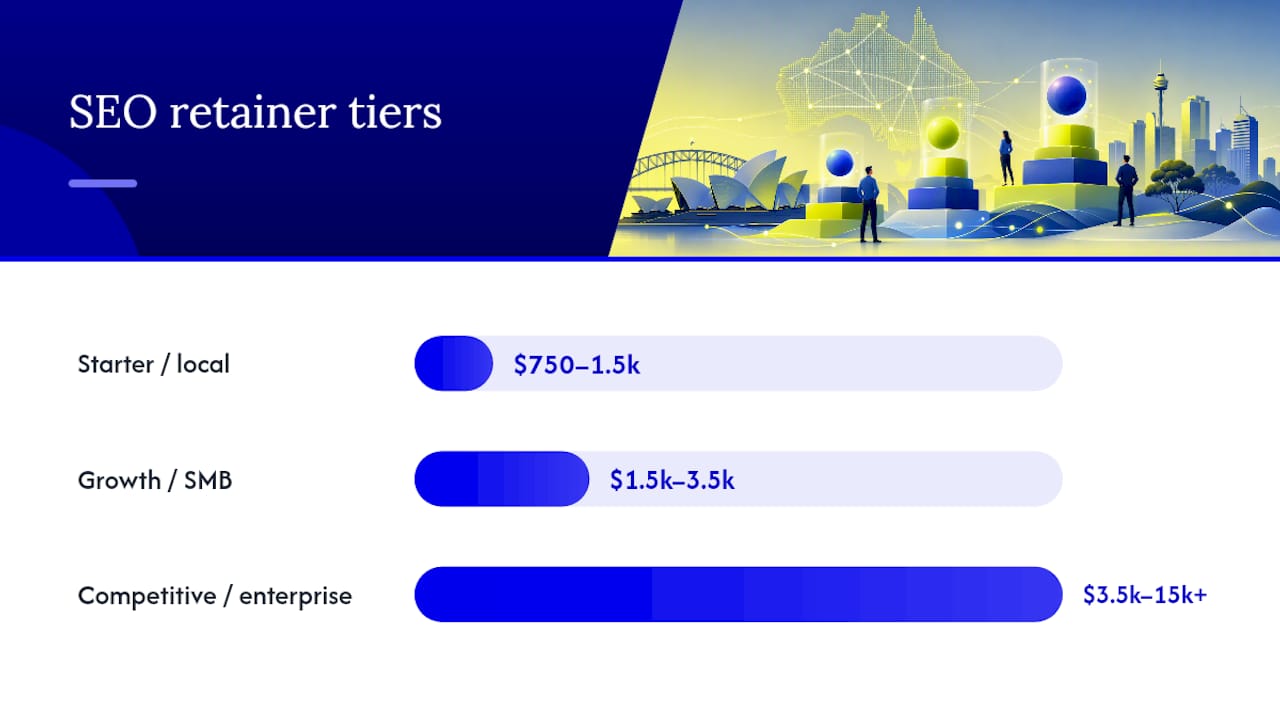
Three bands cover almost everyone:
Entry/local ($750–$1,500/month): suits single-location businesses in low-competition suburbs or niches.
Growth/SMB ($1,500–$3,500/month): the default choice for most city-based SMEs competing on real commercial keywords.
Competitive/enterprise ($3,500–$15,000+/month): for multi-location brands or crowded metro sectors like legal, real estate, and finance.
If you’re starting from zero, budget at least $1,500 per month and commit to six months minimum. Anything less, and you’re paying for activity without the content or link-building that produces movement.
Key Takeaways
Effective SEO in Australia costs $1,500 to $3,500 a month for most SMEs, and the price gap between quotes almost always comes down to hours, content volume, and authority-building scope.
Point | Details |
|---|---|
Budget the growth tier | Most Australian SMEs should target $1,500–$3,500/month for real content and technical work. |
Convert quotes to hours | At $140–$250/hr, work out how many hours your retainer actually buys before comparing. |
Avoid sub-$1,000 packages | Retainers under roughly $1,000/month usually skip content or link building entirely. |
Expect a six to twelve month runway | Early movement appears around month three; meaningful results build from month six. |
Start with a scoped audit | Sun State Digital prices retainers off a scoped audit and clear KPIs, not a generic rate card. |
Table of Contents
How much does SEO cost in Australia, and where do the numbers come from?
What do you actually get for your money at each price point?
Retainer, hourly, project, or performance: which pricing model fits?
Why do two SEO quotes for the same business differ by 300%?
What deliverables and one-off costs should you expect at each price point?
How do you compare SEO quotes without getting burned?
How long until SEO shows results, and what’s the ROI?
What proof does Sun State Digital offer that this pricing model works?
What does ROI actually look like across the different pricing tiers?
How are 2026 SEO trends changing what you pay for?
Does SEO pricing vary between Brisbane, Sydney, Melbourne, and regional Australia?
Where do businesses go wrong when budgeting for SEO?
Ready to find out what SEO should actually cost for your business?
Sources
How much does SEO cost in Australia, and where do the numbers come from?
Agencies don’t pull retainer prices out of thin air. They start with an hourly rate, estimate the hours your website needs each month, and multiply. Understanding that maths is the fastest way to tell a fair quote from an inflated one.
Australian SEO pricing in 2026 typically sits between $1,500 and $3,000 per month for most small businesses, with local starter campaigns from $750–$1,500/month and competitive metro sectors running $3,000–$6,000. Enterprise programmes with multiple locations or national reach can exceed $10,000 a month. Sydney and Melbourne agencies tend to sit at the top of these ranges given higher overheads and fiercer competition for talent; Brisbane, the Sunshine Coast, and regional centres generally price a notch lower for comparable work.
Here’s the maths behind it. Agency hourly rates in Australia commonly range from $140 to $250 per hour. At $180/hr, a $1,500 monthly retainer buys roughly 8 hours of work; a $3,000 retainer funds closer to 16 to 17 hours.
Eight hours a month covers basic technical maintenance and minor content tweaks, not much else.
Sixteen to seventeen hours starts to fund actual content production, on-page optimisation, and some outreach.
Anything below roughly $1,000 a month rarely covers more than a handful of hours, which is why cheap retainers so often stall.
Once you know the hourly rate an agency is quoting, you can work backwards and ask exactly what those hours are being spent on.
What do you actually get for your money at each price point?
Pricing tiers only mean something once you attach deliverables to them. A $1,500 retainer and a $5,000 retainer aren’t the same service delivered at different speeds. They’re fundamentally different scopes of work.
Starter/local tier ($750–$1,500/month). This suits a single-location tradie, café, or clinic competing in a low-competition suburb. Expect monthly on-page fixes, basic Google Business Profile management, a handful of local citations, and maybe one piece of content a month. It’s maintenance-grade SEO, not growth SEO.
Growth/SMB tier ($1,500–$3,500/month). This is the best-value band for most Australian SMEs targeting city-level keywords. It typically funds two to four content pieces a month, ongoing technical audits, structured internal linking, basic digital PR or outreach, and monthly performance reporting with commentary, not just a dashboard screenshot.
Competitive/enterprise tier ($3,500–$15,000+/month). Reserved for multi-location franchises, national brands, or sectors like finance, legal, and real estate where every competitor is also spending heavily. This tier funds dedicated content teams, aggressive link acquisition, technical work across large site architectures, and often weekly reporting cadences.
What separates these tiers isn’t cleverness. It’s volume and consistency. A starter package might produce one blog post; a growth package produces four, backed by a content calendar and keyword mapping. A competitive package adds a public relations layer, chasing coverage and backlinks from genuine industry publications rather than directories.
Content deliverables scale the same way. Where a starter tier might touch a handful of pages a month, a growth tier typically covers your full core service pages plus a running blog cadence, and an enterprise tier adds landing page variants for each location or region.
Retainer, hourly, project, or performance: which pricing model fits?
The pricing model you choose shapes both your cash flow and your risk. Most Australian agencies offer some combination of the four, and each suits a different situation.
Monthly retainer: the dominant model, usually $1,500–$7,000/month. SEO compounds over time, so ongoing investment consistently outperforms one-off projects for sustained growth. Best for businesses committing to at least six months.
Hourly billing: typically $140–$250/hr, suited to small, defined tasks like fixing a technical issue or auditing a site migration rather than ongoing growth work.
Project-based pricing: a fixed fee for a defined scope, such as an audit or a site relaunch, useful when you need a specific outcome without an open-ended commitment.
Performance-based pricing: fees tied to ranking or traffic milestones. Rare in Australia and worth scrutinising carefully, since it can incentivise short-term ranking tricks over sustainable growth.
Whichever model you choose, insist on a written statement of work with clear milestones and KPIs attached. A one-page SOW that specifies deliverables, timelines, and reporting cadence protects you from scope creep just as much as it protects the agency from unrealistic expectations.
Why do two SEO quotes for the same business differ by 300%?
Get three quotes for the same website and you’ll often see numbers ranging from $1,200 to $4,500 a month. That gap isn’t necessarily one agency ripping you off. It usually reflects genuinely different assumptions about the work involved.
Keyword competition. Ranking a plumber in a small regional town is a different job to ranking a mortgage broker in inner Sydney.
Site health. A site riddled with legacy technical debt, broken redirects, or a slow, bloated CMS needs remediation hours before any growth work can start.
Content demands. Technical or regulated industries (finance, health, legal) need writers with subject expertise, which costs more than general content production.
Authority building. Competitive sectors need digital PR and link acquisition, which is time-intensive and harder to scale than on-page work.
Multi-location complexity. Every additional location multiplies the local SEO workload, from citations to location-specific content.
Speed of delivery. Faster timelines demand dedicated senior time and accelerated outreach, which agencies price at a premium.
Pro Tip: Ask any agency to walk you through why your site sits where it does on their pricing scale. A good agency can point to specific technical debt, content gaps, or competitor strength. A vague answer is a sign they haven’t actually looked at your site yet.
What deliverables and one-off costs should you expect at each price point?
Monthly deliverables should scale directly with what you’re paying, and one-off project costs follow a fairly consistent pattern across Australian agencies.
Entry-tier retainers usually provide a limited number of content pieces monthly, basic technical checks, and simple reports.
Growth-tier retainers deliver several content pieces monthly, ongoing audits, outreach, and detailed reporting with commentary.
Competitive-tier retainers include dedicated content production, link building, and frequent strategic reviews.
Project-based work sits outside the monthly retainer and follows its own pricing logic.
Project type | Typical Australian price range |
|---|---|
Comprehensive SEO audit | $1,500–$10,000 (varies by site size) |
Website migration | $3,000–$10,000+ |
Agency-authored content | $0.15–$0.40 per word |
If you’re budgeting for a 1,500 word cornerstone page at $0.30 per word, that’s $450 in content alone, on top of the strategic work of deciding what to write and why. Factor that into any content-heavy growth plan before you sign.
How do you compare SEO quotes without getting burned?
Comparing three proposals side by side is harder than it sounds, because agencies rarely quote in the same units. One might quote hours, another deliverables, another vague “strategy and optimisation.”
Ask exactly how many hours the retainer buys and at what blended rate. This is the single fastest way to compare quotes on equal terms.
Ask what’s included in content and outreach, and whether either is quoted separately. Some retainers look cheap until you discover content is billed on top.
Ask for a sample report from an existing client (anonymised is fine). If the agency can’t produce one, that’s a red flag.
Ask how they’ll report on cost per lead, not just rankings. Rankings without a link to leads or revenue are a vanity metric.
Ask what happens if targets aren’t hit by month six. A serious agency has a plan; a weak one gets defensive.
Red flags worth walking away from: guaranteed #1 rankings, contracts that lock you in for 12 months with no exit clause, and pricing dramatically below the $750/month floor that most legitimate Australian agencies work to.
Pro Tip: Normalise every quote by converting deliverables into estimated hours. A “comprehensive monthly optimisation package” for $1,200 that works out to four hours of actual time is a worse deal than a plainly stated eight-hour retainer at the same price.
How long until SEO shows results, and what’s the ROI?
Expect early movement around the three-month mark and meaningful, compounding results between six and twelve months for most SMEs. Competitive or enterprise programmes with heavier investment can show measurable gains sooner, simply because more hours are going in from day one.
Track these KPIs monthly, not just rankings:
Organic traffic growth month on month
Qualified leads generated from organic search
Conversion rate from organic visitors to enquiries
Cost per lead compared against your paid channels
Here’s a worked example. A $2,500/month retainer over six months costs $15,000. If that campaign generates 20 additional qualified leads a month by month six, and your average customer value is $1,200, converting even 15% of those leads (three customers) returns $3,600 in a single month, before you factor in repeat business. Understanding how those leads convert once they land on your site matters just as much as the traffic number itself.
What proof does Sun State Digital offer that this pricing model works?
Numbers on a page mean little without evidence they translate into real business outcomes. Sun State Digital’s work with Ray White Aspley is a useful example: a scoped, strategy-first approach to local search and lead generation that significantly cut lead acquisition costs for a real estate business competing in a genuinely crowded Brisbane market.
The quoting process behind that work follows a consistent structure:
A scoped audit first, establishing exactly where the site stands technically and competitively.
A tiered proposal matched to the business’s actual competitive position, not a generic package.
Clear KPIs and reporting cadence agreed before any retainer begins.
Strategy before spending means you know exactly what problem your budget is solving before a single dollar moves. That’s the difference between an SEO invoice and an SEO investment.
If you want to see where your own site sits before committing to a number, requesting a scoped audit is the logical first step.
What does ROI actually look like across the different pricing tiers?
The relationship between spend and return isn’t linear, and that catches a lot of Australian business owners out. An entry-tier retainer of $1,000 a month on a low-competition local keyword can deliver strong relative ROI quickly, because there’s less resistance to overcome and a smaller pool of competitors to outrank.
A growth-tier retainer of $2,500 a month targeting city-wide commercial keywords takes longer to show the same percentage return, but the absolute dollar value tends to be far higher once it does, simply because the addressable market is bigger. A real estate agency or a specialist trades business operating across a metro area will typically see a slower first ninety days followed by a steeper climb from month four onward, as content and authority-building work starts compounding.

Enterprise-tier spend, $7,000 a month and up, behaves differently again. The ROI calculation there is rarely about a single keyword ranking. It’s about aggregate visibility across dozens or hundreds of location and service pages, where a 5% traffic lift across the whole site can outweigh a single page rocketing to position one. Businesses evaluating this tier should judge success on blended cost per lead across the whole program, not any individual ranking. Whatever tier you’re assessing, the underlying question stays the same: what does a single converted lead cost you through this channel, compared to what you’re currently paying through paid ads or referrals?
How are 2026 SEO trends changing what you pay for?
AI-powered search has changed what a competitive SEO retainer needs to fund, and pricing is starting to reflect that. Google’s AI Overviews and other generative search features mean visibility now depends on more than ranking a blue link. It depends on being the source an AI system chooses to summarise or cite.
That shift has pushed some agencies to add structured data markup, more rigorous entity and citation-building, and deeper topical content clusters into their standard growth-tier scope, work that used to be an optional add-on. Understanding how AI is reshaping local search behaviour is now a genuine part of what a competent retainer should cover, not a separate line item.
Practically, this means growth-tier retainers in 2026 tend to include more structured content work (FAQ schema, clear entity definitions, comparison tables) than they did a couple of years ago, at a similar price point. Businesses evaluating agencies should ask directly whether AI-search visibility is part of the standard scope or billed as an extra. Agencies applying AI systems to their own local search strategy tend to have a clearer answer to that question than those still running a 2020-era playbook.
The other trend worth watching is speed of content production. AI tools have made first-draft content faster to produce, which has, if anything, increased the emphasis agencies place on editorial review, fact-checking, and genuine subject expertise as the differentiator, rather than driven prices down.
Does SEO pricing vary between Brisbane, Sydney, Melbourne, and regional Australia?
Location still moves the number, even in a market where most SEO work happens remotely. Sydney and Melbourne agencies generally sit at the higher end of national ranges, driven by higher office and staff costs and by fiercer competition for the same client budgets.
Brisbane and the Sunshine Coast typically price a step below that, offering comparable growth-tier work without the Sydney or Melbourne premium. This isn’t a quality gap. It’s an overhead and local market-rate difference that shows up directly in retainer pricing.
Regional and rural Australian businesses often face a different dynamic entirely: lower competition for keywords, but also fewer specialist agencies with genuine local market knowledge to choose from. That can mean cheaper base pricing but a smaller pool of agencies who understand a regional market’s specific search behaviour, so it pays to ask any prospective agency directly about their experience with businesses in your specific region rather than assuming national experience translates automatically.
Multi-location businesses spanning several of these markets face a compounding effect: pricing typically scales per location added, since each location genuinely needs its own citations, localised content, and Google Business Profile management rather than a single generic page duplicated across suburbs.
Where do businesses go wrong when budgeting for SEO?
The most common mistake isn’t overspending. It’s underbudgeting for long enough to see a growth-tier campaign actually compound, then pulling the pin at month four out of impatience.
If your budget is tight, a three-month pilot at the entry tier, paired with paid search running in parallel, gives you faster signal on what converts while SEO builds underneath it. Once you see which keywords and pages are converting through paid, shift that budget toward SEO retainer with confidence, rather than guessing.
Ready to find out what SEO should actually cost for your business?
Sun State Digital prices SEO around a scoped audit first, not a generic package pulled from a rate card, so you know exactly what problem your budget is solving before you commit a dollar. For a Brisbane or Sunshine Coast business weighing up a $1,500 retainer against a $5,000 one, that starting audit is the difference between guessing your tier and knowing it.
Our SEO and local search service covers everything from technical audits through to ongoing growth retainers, built around the same strategy-first approach that helped cut lead costs for Ray White Aspley. If you want a clear, scoped quote rather than a rough estimate, request an audit and we’ll map out exactly what your site needs and what it should cost to fix.
Sources
Recommended
Stay Inspired
Get fresh design insights, articles, and resources delivered straight to your inbox.
Latest Blogs



Stay Inspired
Get fresh design insights, articles, and resources delivered straight to your inbox.
Insights
Aug 20, 2026
SEO pricing in Australia: what you'll actually pay in 2026
SEO pricing in Australia: what you'll actually pay in 2026
Discover what SEO pricing in Australia will look like in 2026, and how to budget effectively for impactful results in your business.
Discover what SEO pricing in Australia will look like in 2026, and how to budget effectively for impactful results in your business.
SEO pricing in Australia: what you’ll actually pay in 2026
Most Australian small and medium businesses should budget $1,500 to $3,000 per month for effective SEO in 2026. That’s the sweet spot that funds real content, technical fixes, and the authority-building work that actually moves rankings, without paying enterprise rates for a local service business.
Three bands cover almost everyone:
Entry/local ($750–$1,500/month): suits single-location businesses in low-competition suburbs or niches.
Growth/SMB ($1,500–$3,500/month): the default choice for most city-based SMEs competing on real commercial keywords.
Competitive/enterprise ($3,500–$15,000+/month): for multi-location brands or crowded metro sectors like legal, real estate, and finance.
If you’re starting from zero, budget at least $1,500 per month and commit to six months minimum. Anything less, and you’re paying for activity without the content or link-building that produces movement.
Key Takeaways
Effective SEO in Australia costs $1,500 to $3,500 a month for most SMEs, and the price gap between quotes almost always comes down to hours, content volume, and authority-building scope.
Point | Details |
|---|---|
Budget the growth tier | Most Australian SMEs should target $1,500–$3,500/month for real content and technical work. |
Convert quotes to hours | At $140–$250/hr, work out how many hours your retainer actually buys before comparing. |
Avoid sub-$1,000 packages | Retainers under roughly $1,000/month usually skip content or link building entirely. |
Expect a six to twelve month runway | Early movement appears around month three; meaningful results build from month six. |
Start with a scoped audit | Sun State Digital prices retainers off a scoped audit and clear KPIs, not a generic rate card. |
Table of Contents
How much does SEO cost in Australia, and where do the numbers come from?
What do you actually get for your money at each price point?
Retainer, hourly, project, or performance: which pricing model fits?
Why do two SEO quotes for the same business differ by 300%?
What deliverables and one-off costs should you expect at each price point?
How do you compare SEO quotes without getting burned?
How long until SEO shows results, and what’s the ROI?
What proof does Sun State Digital offer that this pricing model works?
What does ROI actually look like across the different pricing tiers?
How are 2026 SEO trends changing what you pay for?
Does SEO pricing vary between Brisbane, Sydney, Melbourne, and regional Australia?
Where do businesses go wrong when budgeting for SEO?
Ready to find out what SEO should actually cost for your business?
Sources
How much does SEO cost in Australia, and where do the numbers come from?
Agencies don’t pull retainer prices out of thin air. They start with an hourly rate, estimate the hours your website needs each month, and multiply. Understanding that maths is the fastest way to tell a fair quote from an inflated one.
Australian SEO pricing in 2026 typically sits between $1,500 and $3,000 per month for most small businesses, with local starter campaigns from $750–$1,500/month and competitive metro sectors running $3,000–$6,000. Enterprise programmes with multiple locations or national reach can exceed $10,000 a month. Sydney and Melbourne agencies tend to sit at the top of these ranges given higher overheads and fiercer competition for talent; Brisbane, the Sunshine Coast, and regional centres generally price a notch lower for comparable work.
Here’s the maths behind it. Agency hourly rates in Australia commonly range from $140 to $250 per hour. At $180/hr, a $1,500 monthly retainer buys roughly 8 hours of work; a $3,000 retainer funds closer to 16 to 17 hours.
Eight hours a month covers basic technical maintenance and minor content tweaks, not much else.
Sixteen to seventeen hours starts to fund actual content production, on-page optimisation, and some outreach.
Anything below roughly $1,000 a month rarely covers more than a handful of hours, which is why cheap retainers so often stall.
Once you know the hourly rate an agency is quoting, you can work backwards and ask exactly what those hours are being spent on.
What do you actually get for your money at each price point?
Pricing tiers only mean something once you attach deliverables to them. A $1,500 retainer and a $5,000 retainer aren’t the same service delivered at different speeds. They’re fundamentally different scopes of work.
Starter/local tier ($750–$1,500/month). This suits a single-location tradie, café, or clinic competing in a low-competition suburb. Expect monthly on-page fixes, basic Google Business Profile management, a handful of local citations, and maybe one piece of content a month. It’s maintenance-grade SEO, not growth SEO.
Growth/SMB tier ($1,500–$3,500/month). This is the best-value band for most Australian SMEs targeting city-level keywords. It typically funds two to four content pieces a month, ongoing technical audits, structured internal linking, basic digital PR or outreach, and monthly performance reporting with commentary, not just a dashboard screenshot.
Competitive/enterprise tier ($3,500–$15,000+/month). Reserved for multi-location franchises, national brands, or sectors like finance, legal, and real estate where every competitor is also spending heavily. This tier funds dedicated content teams, aggressive link acquisition, technical work across large site architectures, and often weekly reporting cadences.
What separates these tiers isn’t cleverness. It’s volume and consistency. A starter package might produce one blog post; a growth package produces four, backed by a content calendar and keyword mapping. A competitive package adds a public relations layer, chasing coverage and backlinks from genuine industry publications rather than directories.
Content deliverables scale the same way. Where a starter tier might touch a handful of pages a month, a growth tier typically covers your full core service pages plus a running blog cadence, and an enterprise tier adds landing page variants for each location or region.
Retainer, hourly, project, or performance: which pricing model fits?
The pricing model you choose shapes both your cash flow and your risk. Most Australian agencies offer some combination of the four, and each suits a different situation.
Monthly retainer: the dominant model, usually $1,500–$7,000/month. SEO compounds over time, so ongoing investment consistently outperforms one-off projects for sustained growth. Best for businesses committing to at least six months.
Hourly billing: typically $140–$250/hr, suited to small, defined tasks like fixing a technical issue or auditing a site migration rather than ongoing growth work.
Project-based pricing: a fixed fee for a defined scope, such as an audit or a site relaunch, useful when you need a specific outcome without an open-ended commitment.
Performance-based pricing: fees tied to ranking or traffic milestones. Rare in Australia and worth scrutinising carefully, since it can incentivise short-term ranking tricks over sustainable growth.
Whichever model you choose, insist on a written statement of work with clear milestones and KPIs attached. A one-page SOW that specifies deliverables, timelines, and reporting cadence protects you from scope creep just as much as it protects the agency from unrealistic expectations.
Why do two SEO quotes for the same business differ by 300%?
Get three quotes for the same website and you’ll often see numbers ranging from $1,200 to $4,500 a month. That gap isn’t necessarily one agency ripping you off. It usually reflects genuinely different assumptions about the work involved.
Keyword competition. Ranking a plumber in a small regional town is a different job to ranking a mortgage broker in inner Sydney.
Site health. A site riddled with legacy technical debt, broken redirects, or a slow, bloated CMS needs remediation hours before any growth work can start.
Content demands. Technical or regulated industries (finance, health, legal) need writers with subject expertise, which costs more than general content production.
Authority building. Competitive sectors need digital PR and link acquisition, which is time-intensive and harder to scale than on-page work.
Multi-location complexity. Every additional location multiplies the local SEO workload, from citations to location-specific content.
Speed of delivery. Faster timelines demand dedicated senior time and accelerated outreach, which agencies price at a premium.
Pro Tip: Ask any agency to walk you through why your site sits where it does on their pricing scale. A good agency can point to specific technical debt, content gaps, or competitor strength. A vague answer is a sign they haven’t actually looked at your site yet.
What deliverables and one-off costs should you expect at each price point?
Monthly deliverables should scale directly with what you’re paying, and one-off project costs follow a fairly consistent pattern across Australian agencies.
Entry-tier retainers usually provide a limited number of content pieces monthly, basic technical checks, and simple reports.
Growth-tier retainers deliver several content pieces monthly, ongoing audits, outreach, and detailed reporting with commentary.
Competitive-tier retainers include dedicated content production, link building, and frequent strategic reviews.
Project-based work sits outside the monthly retainer and follows its own pricing logic.
Project type | Typical Australian price range |
|---|---|
Comprehensive SEO audit | $1,500–$10,000 (varies by site size) |
Website migration | $3,000–$10,000+ |
Agency-authored content | $0.15–$0.40 per word |
If you’re budgeting for a 1,500 word cornerstone page at $0.30 per word, that’s $450 in content alone, on top of the strategic work of deciding what to write and why. Factor that into any content-heavy growth plan before you sign.
How do you compare SEO quotes without getting burned?
Comparing three proposals side by side is harder than it sounds, because agencies rarely quote in the same units. One might quote hours, another deliverables, another vague “strategy and optimisation.”
Ask exactly how many hours the retainer buys and at what blended rate. This is the single fastest way to compare quotes on equal terms.
Ask what’s included in content and outreach, and whether either is quoted separately. Some retainers look cheap until you discover content is billed on top.
Ask for a sample report from an existing client (anonymised is fine). If the agency can’t produce one, that’s a red flag.
Ask how they’ll report on cost per lead, not just rankings. Rankings without a link to leads or revenue are a vanity metric.
Ask what happens if targets aren’t hit by month six. A serious agency has a plan; a weak one gets defensive.
Red flags worth walking away from: guaranteed #1 rankings, contracts that lock you in for 12 months with no exit clause, and pricing dramatically below the $750/month floor that most legitimate Australian agencies work to.
Pro Tip: Normalise every quote by converting deliverables into estimated hours. A “comprehensive monthly optimisation package” for $1,200 that works out to four hours of actual time is a worse deal than a plainly stated eight-hour retainer at the same price.
How long until SEO shows results, and what’s the ROI?
Expect early movement around the three-month mark and meaningful, compounding results between six and twelve months for most SMEs. Competitive or enterprise programmes with heavier investment can show measurable gains sooner, simply because more hours are going in from day one.
Track these KPIs monthly, not just rankings:
Organic traffic growth month on month
Qualified leads generated from organic search
Conversion rate from organic visitors to enquiries
Cost per lead compared against your paid channels
Here’s a worked example. A $2,500/month retainer over six months costs $15,000. If that campaign generates 20 additional qualified leads a month by month six, and your average customer value is $1,200, converting even 15% of those leads (three customers) returns $3,600 in a single month, before you factor in repeat business. Understanding how those leads convert once they land on your site matters just as much as the traffic number itself.
What proof does Sun State Digital offer that this pricing model works?
Numbers on a page mean little without evidence they translate into real business outcomes. Sun State Digital’s work with Ray White Aspley is a useful example: a scoped, strategy-first approach to local search and lead generation that significantly cut lead acquisition costs for a real estate business competing in a genuinely crowded Brisbane market.
The quoting process behind that work follows a consistent structure:
A scoped audit first, establishing exactly where the site stands technically and competitively.
A tiered proposal matched to the business’s actual competitive position, not a generic package.
Clear KPIs and reporting cadence agreed before any retainer begins.
Strategy before spending means you know exactly what problem your budget is solving before a single dollar moves. That’s the difference between an SEO invoice and an SEO investment.
If you want to see where your own site sits before committing to a number, requesting a scoped audit is the logical first step.
What does ROI actually look like across the different pricing tiers?
The relationship between spend and return isn’t linear, and that catches a lot of Australian business owners out. An entry-tier retainer of $1,000 a month on a low-competition local keyword can deliver strong relative ROI quickly, because there’s less resistance to overcome and a smaller pool of competitors to outrank.
A growth-tier retainer of $2,500 a month targeting city-wide commercial keywords takes longer to show the same percentage return, but the absolute dollar value tends to be far higher once it does, simply because the addressable market is bigger. A real estate agency or a specialist trades business operating across a metro area will typically see a slower first ninety days followed by a steeper climb from month four onward, as content and authority-building work starts compounding.
Enterprise-tier spend, $7,000 a month and up, behaves differently again. The ROI calculation there is rarely about a single keyword ranking. It’s about aggregate visibility across dozens or hundreds of location and service pages, where a 5% traffic lift across the whole site can outweigh a single page rocketing to position one. Businesses evaluating this tier should judge success on blended cost per lead across the whole program, not any individual ranking. Whatever tier you’re assessing, the underlying question stays the same: what does a single converted lead cost you through this channel, compared to what you’re currently paying through paid ads or referrals?
How are 2026 SEO trends changing what you pay for?
AI-powered search has changed what a competitive SEO retainer needs to fund, and pricing is starting to reflect that. Google’s AI Overviews and other generative search features mean visibility now depends on more than ranking a blue link. It depends on being the source an AI system chooses to summarise or cite.
That shift has pushed some agencies to add structured data markup, more rigorous entity and citation-building, and deeper topical content clusters into their standard growth-tier scope, work that used to be an optional add-on. Understanding how AI is reshaping local search behaviour is now a genuine part of what a competent retainer should cover, not a separate line item.
Practically, this means growth-tier retainers in 2026 tend to include more structured content work (FAQ schema, clear entity definitions, comparison tables) than they did a couple of years ago, at a similar price point. Businesses evaluating agencies should ask directly whether AI-search visibility is part of the standard scope or billed as an extra. Agencies applying AI systems to their own local search strategy tend to have a clearer answer to that question than those still running a 2020-era playbook.
The other trend worth watching is speed of content production. AI tools have made first-draft content faster to produce, which has, if anything, increased the emphasis agencies place on editorial review, fact-checking, and genuine subject expertise as the differentiator, rather than driven prices down.
Does SEO pricing vary between Brisbane, Sydney, Melbourne, and regional Australia?
Location still moves the number, even in a market where most SEO work happens remotely. Sydney and Melbourne agencies generally sit at the higher end of national ranges, driven by higher office and staff costs and by fiercer competition for the same client budgets.
Brisbane and the Sunshine Coast typically price a step below that, offering comparable growth-tier work without the Sydney or Melbourne premium. This isn’t a quality gap. It’s an overhead and local market-rate difference that shows up directly in retainer pricing.
Regional and rural Australian businesses often face a different dynamic entirely: lower competition for keywords, but also fewer specialist agencies with genuine local market knowledge to choose from. That can mean cheaper base pricing but a smaller pool of agencies who understand a regional market’s specific search behaviour, so it pays to ask any prospective agency directly about their experience with businesses in your specific region rather than assuming national experience translates automatically.
Multi-location businesses spanning several of these markets face a compounding effect: pricing typically scales per location added, since each location genuinely needs its own citations, localised content, and Google Business Profile management rather than a single generic page duplicated across suburbs.
Where do businesses go wrong when budgeting for SEO?
The most common mistake isn’t overspending. It’s underbudgeting for long enough to see a growth-tier campaign actually compound, then pulling the pin at month four out of impatience.
If your budget is tight, a three-month pilot at the entry tier, paired with paid search running in parallel, gives you faster signal on what converts while SEO builds underneath it. Once you see which keywords and pages are converting through paid, shift that budget toward SEO retainer with confidence, rather than guessing.
Ready to find out what SEO should actually cost for your business?
Sun State Digital prices SEO around a scoped audit first, not a generic package pulled from a rate card, so you know exactly what problem your budget is solving before you commit a dollar. For a Brisbane or Sunshine Coast business weighing up a $1,500 retainer against a $5,000 one, that starting audit is the difference between guessing your tier and knowing it.
Our SEO and local search service covers everything from technical audits through to ongoing growth retainers, built around the same strategy-first approach that helped cut lead costs for Ray White Aspley. If you want a clear, scoped quote rather than a rough estimate, request an audit and we’ll map out exactly what your site needs and what it should cost to fix.
Sources
Recommended
Stay Inspired
Get fresh design insights, articles, and resources delivered straight to your inbox.
Latest Blogs
Stay Inspired
Get fresh design insights, articles, and resources delivered straight to your inbox.
Insights
Aug 20, 2026
SEO pricing in Australia: what you'll actually pay in 2026
SEO pricing in Australia: what you'll actually pay in 2026
Discover what SEO pricing in Australia will look like in 2026, and how to budget effectively for impactful results in your business.
Discover what SEO pricing in Australia will look like in 2026, and how to budget effectively for impactful results in your business.
SEO pricing in Australia: what you’ll actually pay in 2026
Most Australian small and medium businesses should budget $1,500 to $3,000 per month for effective SEO in 2026. That’s the sweet spot that funds real content, technical fixes, and the authority-building work that actually moves rankings, without paying enterprise rates for a local service business.
Three bands cover almost everyone:
Entry/local ($750–$1,500/month): suits single-location businesses in low-competition suburbs or niches.
Growth/SMB ($1,500–$3,500/month): the default choice for most city-based SMEs competing on real commercial keywords.
Competitive/enterprise ($3,500–$15,000+/month): for multi-location brands or crowded metro sectors like legal, real estate, and finance.
If you’re starting from zero, budget at least $1,500 per month and commit to six months minimum. Anything less, and you’re paying for activity without the content or link-building that produces movement.
Key Takeaways
Effective SEO in Australia costs $1,500 to $3,500 a month for most SMEs, and the price gap between quotes almost always comes down to hours, content volume, and authority-building scope.
Point | Details |
|---|---|
Budget the growth tier | Most Australian SMEs should target $1,500–$3,500/month for real content and technical work. |
Convert quotes to hours | At $140–$250/hr, work out how many hours your retainer actually buys before comparing. |
Avoid sub-$1,000 packages | Retainers under roughly $1,000/month usually skip content or link building entirely. |
Expect a six to twelve month runway | Early movement appears around month three; meaningful results build from month six. |
Start with a scoped audit | Sun State Digital prices retainers off a scoped audit and clear KPIs, not a generic rate card. |
Table of Contents
How much does SEO cost in Australia, and where do the numbers come from?
What do you actually get for your money at each price point?
Retainer, hourly, project, or performance: which pricing model fits?
Why do two SEO quotes for the same business differ by 300%?
What deliverables and one-off costs should you expect at each price point?
How do you compare SEO quotes without getting burned?
How long until SEO shows results, and what’s the ROI?
What proof does Sun State Digital offer that this pricing model works?
What does ROI actually look like across the different pricing tiers?
How are 2026 SEO trends changing what you pay for?
Does SEO pricing vary between Brisbane, Sydney, Melbourne, and regional Australia?
Where do businesses go wrong when budgeting for SEO?
Ready to find out what SEO should actually cost for your business?
Sources
How much does SEO cost in Australia, and where do the numbers come from?
Agencies don’t pull retainer prices out of thin air. They start with an hourly rate, estimate the hours your website needs each month, and multiply. Understanding that maths is the fastest way to tell a fair quote from an inflated one.
Australian SEO pricing in 2026 typically sits between $1,500 and $3,000 per month for most small businesses, with local starter campaigns from $750–$1,500/month and competitive metro sectors running $3,000–$6,000. Enterprise programmes with multiple locations or national reach can exceed $10,000 a month. Sydney and Melbourne agencies tend to sit at the top of these ranges given higher overheads and fiercer competition for talent; Brisbane, the Sunshine Coast, and regional centres generally price a notch lower for comparable work.
Here’s the maths behind it. Agency hourly rates in Australia commonly range from $140 to $250 per hour. At $180/hr, a $1,500 monthly retainer buys roughly 8 hours of work; a $3,000 retainer funds closer to 16 to 17 hours.
Eight hours a month covers basic technical maintenance and minor content tweaks, not much else.
Sixteen to seventeen hours starts to fund actual content production, on-page optimisation, and some outreach.
Anything below roughly $1,000 a month rarely covers more than a handful of hours, which is why cheap retainers so often stall.
Once you know the hourly rate an agency is quoting, you can work backwards and ask exactly what those hours are being spent on.
What do you actually get for your money at each price point?
Pricing tiers only mean something once you attach deliverables to them. A $1,500 retainer and a $5,000 retainer aren’t the same service delivered at different speeds. They’re fundamentally different scopes of work.
Starter/local tier ($750–$1,500/month). This suits a single-location tradie, café, or clinic competing in a low-competition suburb. Expect monthly on-page fixes, basic Google Business Profile management, a handful of local citations, and maybe one piece of content a month. It’s maintenance-grade SEO, not growth SEO.
Growth/SMB tier ($1,500–$3,500/month). This is the best-value band for most Australian SMEs targeting city-level keywords. It typically funds two to four content pieces a month, ongoing technical audits, structured internal linking, basic digital PR or outreach, and monthly performance reporting with commentary, not just a dashboard screenshot.
Competitive/enterprise tier ($3,500–$15,000+/month). Reserved for multi-location franchises, national brands, or sectors like finance, legal, and real estate where every competitor is also spending heavily. This tier funds dedicated content teams, aggressive link acquisition, technical work across large site architectures, and often weekly reporting cadences.
What separates these tiers isn’t cleverness. It’s volume and consistency. A starter package might produce one blog post; a growth package produces four, backed by a content calendar and keyword mapping. A competitive package adds a public relations layer, chasing coverage and backlinks from genuine industry publications rather than directories.
Content deliverables scale the same way. Where a starter tier might touch a handful of pages a month, a growth tier typically covers your full core service pages plus a running blog cadence, and an enterprise tier adds landing page variants for each location or region.
Retainer, hourly, project, or performance: which pricing model fits?
The pricing model you choose shapes both your cash flow and your risk. Most Australian agencies offer some combination of the four, and each suits a different situation.
Monthly retainer: the dominant model, usually $1,500–$7,000/month. SEO compounds over time, so ongoing investment consistently outperforms one-off projects for sustained growth. Best for businesses committing to at least six months.
Hourly billing: typically $140–$250/hr, suited to small, defined tasks like fixing a technical issue or auditing a site migration rather than ongoing growth work.
Project-based pricing: a fixed fee for a defined scope, such as an audit or a site relaunch, useful when you need a specific outcome without an open-ended commitment.
Performance-based pricing: fees tied to ranking or traffic milestones. Rare in Australia and worth scrutinising carefully, since it can incentivise short-term ranking tricks over sustainable growth.
Whichever model you choose, insist on a written statement of work with clear milestones and KPIs attached. A one-page SOW that specifies deliverables, timelines, and reporting cadence protects you from scope creep just as much as it protects the agency from unrealistic expectations.
Why do two SEO quotes for the same business differ by 300%?
Get three quotes for the same website and you’ll often see numbers ranging from $1,200 to $4,500 a month. That gap isn’t necessarily one agency ripping you off. It usually reflects genuinely different assumptions about the work involved.
Keyword competition. Ranking a plumber in a small regional town is a different job to ranking a mortgage broker in inner Sydney.
Site health. A site riddled with legacy technical debt, broken redirects, or a slow, bloated CMS needs remediation hours before any growth work can start.
Content demands. Technical or regulated industries (finance, health, legal) need writers with subject expertise, which costs more than general content production.
Authority building. Competitive sectors need digital PR and link acquisition, which is time-intensive and harder to scale than on-page work.
Multi-location complexity. Every additional location multiplies the local SEO workload, from citations to location-specific content.
Speed of delivery. Faster timelines demand dedicated senior time and accelerated outreach, which agencies price at a premium.
Pro Tip: Ask any agency to walk you through why your site sits where it does on their pricing scale. A good agency can point to specific technical debt, content gaps, or competitor strength. A vague answer is a sign they haven’t actually looked at your site yet.
What deliverables and one-off costs should you expect at each price point?
Monthly deliverables should scale directly with what you’re paying, and one-off project costs follow a fairly consistent pattern across Australian agencies.
Entry-tier retainers usually provide a limited number of content pieces monthly, basic technical checks, and simple reports.
Growth-tier retainers deliver several content pieces monthly, ongoing audits, outreach, and detailed reporting with commentary.
Competitive-tier retainers include dedicated content production, link building, and frequent strategic reviews.
Project-based work sits outside the monthly retainer and follows its own pricing logic.
Project type | Typical Australian price range |
|---|---|
Comprehensive SEO audit | $1,500–$10,000 (varies by site size) |
Website migration | $3,000–$10,000+ |
Agency-authored content | $0.15–$0.40 per word |
If you’re budgeting for a 1,500 word cornerstone page at $0.30 per word, that’s $450 in content alone, on top of the strategic work of deciding what to write and why. Factor that into any content-heavy growth plan before you sign.
How do you compare SEO quotes without getting burned?
Comparing three proposals side by side is harder than it sounds, because agencies rarely quote in the same units. One might quote hours, another deliverables, another vague “strategy and optimisation.”
Ask exactly how many hours the retainer buys and at what blended rate. This is the single fastest way to compare quotes on equal terms.
Ask what’s included in content and outreach, and whether either is quoted separately. Some retainers look cheap until you discover content is billed on top.
Ask for a sample report from an existing client (anonymised is fine). If the agency can’t produce one, that’s a red flag.
Ask how they’ll report on cost per lead, not just rankings. Rankings without a link to leads or revenue are a vanity metric.
Ask what happens if targets aren’t hit by month six. A serious agency has a plan; a weak one gets defensive.
Red flags worth walking away from: guaranteed #1 rankings, contracts that lock you in for 12 months with no exit clause, and pricing dramatically below the $750/month floor that most legitimate Australian agencies work to.
Pro Tip: Normalise every quote by converting deliverables into estimated hours. A “comprehensive monthly optimisation package” for $1,200 that works out to four hours of actual time is a worse deal than a plainly stated eight-hour retainer at the same price.
How long until SEO shows results, and what’s the ROI?
Expect early movement around the three-month mark and meaningful, compounding results between six and twelve months for most SMEs. Competitive or enterprise programmes with heavier investment can show measurable gains sooner, simply because more hours are going in from day one.
Track these KPIs monthly, not just rankings:
Organic traffic growth month on month
Qualified leads generated from organic search
Conversion rate from organic visitors to enquiries
Cost per lead compared against your paid channels
Here’s a worked example. A $2,500/month retainer over six months costs $15,000. If that campaign generates 20 additional qualified leads a month by month six, and your average customer value is $1,200, converting even 15% of those leads (three customers) returns $3,600 in a single month, before you factor in repeat business. Understanding how those leads convert once they land on your site matters just as much as the traffic number itself.
What proof does Sun State Digital offer that this pricing model works?
Numbers on a page mean little without evidence they translate into real business outcomes. Sun State Digital’s work with Ray White Aspley is a useful example: a scoped, strategy-first approach to local search and lead generation that significantly cut lead acquisition costs for a real estate business competing in a genuinely crowded Brisbane market.
The quoting process behind that work follows a consistent structure:
A scoped audit first, establishing exactly where the site stands technically and competitively.
A tiered proposal matched to the business’s actual competitive position, not a generic package.
Clear KPIs and reporting cadence agreed before any retainer begins.
Strategy before spending means you know exactly what problem your budget is solving before a single dollar moves. That’s the difference between an SEO invoice and an SEO investment.
If you want to see where your own site sits before committing to a number, requesting a scoped audit is the logical first step.
What does ROI actually look like across the different pricing tiers?
The relationship between spend and return isn’t linear, and that catches a lot of Australian business owners out. An entry-tier retainer of $1,000 a month on a low-competition local keyword can deliver strong relative ROI quickly, because there’s less resistance to overcome and a smaller pool of competitors to outrank.
A growth-tier retainer of $2,500 a month targeting city-wide commercial keywords takes longer to show the same percentage return, but the absolute dollar value tends to be far higher once it does, simply because the addressable market is bigger. A real estate agency or a specialist trades business operating across a metro area will typically see a slower first ninety days followed by a steeper climb from month four onward, as content and authority-building work starts compounding.
Enterprise-tier spend, $7,000 a month and up, behaves differently again. The ROI calculation there is rarely about a single keyword ranking. It’s about aggregate visibility across dozens or hundreds of location and service pages, where a 5% traffic lift across the whole site can outweigh a single page rocketing to position one. Businesses evaluating this tier should judge success on blended cost per lead across the whole program, not any individual ranking. Whatever tier you’re assessing, the underlying question stays the same: what does a single converted lead cost you through this channel, compared to what you’re currently paying through paid ads or referrals?
How are 2026 SEO trends changing what you pay for?
AI-powered search has changed what a competitive SEO retainer needs to fund, and pricing is starting to reflect that. Google’s AI Overviews and other generative search features mean visibility now depends on more than ranking a blue link. It depends on being the source an AI system chooses to summarise or cite.
That shift has pushed some agencies to add structured data markup, more rigorous entity and citation-building, and deeper topical content clusters into their standard growth-tier scope, work that used to be an optional add-on. Understanding how AI is reshaping local search behaviour is now a genuine part of what a competent retainer should cover, not a separate line item.
Practically, this means growth-tier retainers in 2026 tend to include more structured content work (FAQ schema, clear entity definitions, comparison tables) than they did a couple of years ago, at a similar price point. Businesses evaluating agencies should ask directly whether AI-search visibility is part of the standard scope or billed as an extra. Agencies applying AI systems to their own local search strategy tend to have a clearer answer to that question than those still running a 2020-era playbook.
The other trend worth watching is speed of content production. AI tools have made first-draft content faster to produce, which has, if anything, increased the emphasis agencies place on editorial review, fact-checking, and genuine subject expertise as the differentiator, rather than driven prices down.
Does SEO pricing vary between Brisbane, Sydney, Melbourne, and regional Australia?
Location still moves the number, even in a market where most SEO work happens remotely. Sydney and Melbourne agencies generally sit at the higher end of national ranges, driven by higher office and staff costs and by fiercer competition for the same client budgets.
Brisbane and the Sunshine Coast typically price a step below that, offering comparable growth-tier work without the Sydney or Melbourne premium. This isn’t a quality gap. It’s an overhead and local market-rate difference that shows up directly in retainer pricing.
Regional and rural Australian businesses often face a different dynamic entirely: lower competition for keywords, but also fewer specialist agencies with genuine local market knowledge to choose from. That can mean cheaper base pricing but a smaller pool of agencies who understand a regional market’s specific search behaviour, so it pays to ask any prospective agency directly about their experience with businesses in your specific region rather than assuming national experience translates automatically.
Multi-location businesses spanning several of these markets face a compounding effect: pricing typically scales per location added, since each location genuinely needs its own citations, localised content, and Google Business Profile management rather than a single generic page duplicated across suburbs.
Where do businesses go wrong when budgeting for SEO?
The most common mistake isn’t overspending. It’s underbudgeting for long enough to see a growth-tier campaign actually compound, then pulling the pin at month four out of impatience.
If your budget is tight, a three-month pilot at the entry tier, paired with paid search running in parallel, gives you faster signal on what converts while SEO builds underneath it. Once you see which keywords and pages are converting through paid, shift that budget toward SEO retainer with confidence, rather than guessing.
Ready to find out what SEO should actually cost for your business?
Sun State Digital prices SEO around a scoped audit first, not a generic package pulled from a rate card, so you know exactly what problem your budget is solving before you commit a dollar. For a Brisbane or Sunshine Coast business weighing up a $1,500 retainer against a $5,000 one, that starting audit is the difference between guessing your tier and knowing it.
Our SEO and local search service covers everything from technical audits through to ongoing growth retainers, built around the same strategy-first approach that helped cut lead costs for Ray White Aspley. If you want a clear, scoped quote rather than a rough estimate, request an audit and we’ll map out exactly what your site needs and what it should cost to fix.
Sources
Recommended
Stay Inspired
Get fresh design insights, articles, and resources delivered straight to your inbox.
Latest Blogs
Stay Inspired
Get fresh design insights, articles, and resources delivered straight to your inbox.